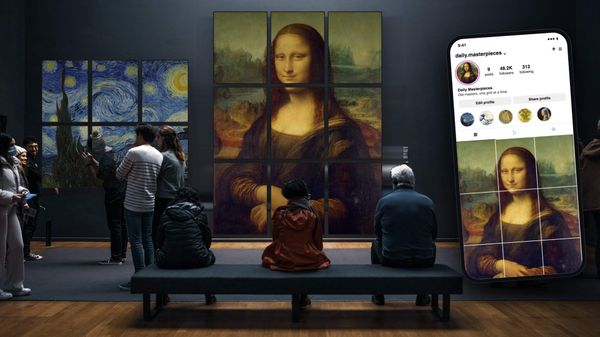
In the Louvre, the Mona Lisa has a wall to herself.
Nobody hangs a souvenir poster next to her. Nobody tapes up last week's sketch. The wall says one thing: look here.
Your Instagram profile is your wall. And when people use Instagram for art, they rarely hang it with the same care.

The same painting on a museum wall and on a profile grid. Museum views in this article are composites built from real gallery photos and public domain paintings.
How do you use Instagram for art?
To use Instagram for art means treating your profile as a curated exhibition, not a feed: the top rows show your strongest work, the bio works like a wall label, and every post leads people toward a studio visit, a commission or a sale. The fastest way to build that is to plan the grid before you post and schedule it, for example with Circleboom's Instagram Grid Maker, which splits one artwork into grid tiles and posts them in the right order.
Table of contents
- Who looks at an artist's Instagram profile
- They decide in seconds
- Your profile is a solo exhibition
- How to use Instagram for art in 7 steps
- 8 masterpieces, 8 grid lessons for artists
- Do the math: one month of posting
- Mistakes that empty the room
- FAQ
Who looks at an artist's Instagram profile
Most artists post for their followers.
The people who change a career are usually not followers yet. They arrive at the profile from a name, a tag, an email or a fair, and they come with a question.
- Gallerists check whether there is a consistent body of work, enough of it, and an audience that cares. A gallery owner who gets a portfolio email will often open Instagram before the attachment.
- Collectors check whether the work is still being made, how it looks at scale and whether the artist is serious. A collector who saw one piece at an art fair looks up the name that evening.
- Curators look for a clear voice and a series they could build a show around.
- Juries for residencies, grants and open calls often ask for your Instagram handle next to the application.
- Art directors and commission clients need proof you can deliver: a style, a process, finished pieces.
- Interior designers and art consultants look for works that fit a room they are furnishing right now.
None of them scroll your whole archive.
They look at the top of your profile and make a call.
The numbers show how much of this now happens on Instagram. In the Art Basel and UBS Survey of Global Collecting 2025, a survey of 3,100 high net worth collectors in 10 markets, 51% of collectors said they had bought art through Instagram, up from 43% in 2023.
51% of high net worth collectors bought art through Instagram, up from 43% two years earlier.
Galleries see the same thing from their side. In an Art Basel article on young collectors, Pearl Lam Galleries said they "often receive inquiries through direct messages on Instagram."
The inquiry comes in through the profile. So the profile has to be ready.
They decide in seconds
How long does a gallerist give your profile?
Not long. A well known 2006 study by Gitte Lindgaard and colleagues at Carleton University, reported in Nature, found that people form a reliable judgment of a web page's visual appeal in about 50 milliseconds, and that the first impression colors everything they judge afterwards.
An Instagram profile is read the same way: a screen of small images, taken in at a glance.
Before anyone reads your bio, they have already seen the first three or four rows of your grid. Those rows answer the real questions:
- Is this a body of work, or a random mix?
- Is this artist active?
- Is the work good enough to look closer?
If the top of the grid shows a blurry studio selfie, a meme and a sale announcement, the answer is already no. The painting that would have won them over sits 40 posts down, where nobody goes.
That is why the top of your profile is the most valuable wall you own.
Your profile is a solo exhibition
Think about what a real solo show gives an artist.
A room. A sequence. A wall label. Good light. Someone who decided what hangs next to what.
Your Instagram profile gives you all of that, and more:
- It never closes. A collector in Tokyo can visit at 3 am.
- It has no opening night. Every day is the opening for someone who just heard your name.
- You are the curator. No gallery decides which works make the cut. You do.
- It travels. Every email signature, business card and fair badge points back to it.
Most guides on Instagram for artists talk about hashtags and reach. Few talk about the wall. Most artists treat Instagram as a place to dump work after it is finished, in whatever order it happens to be photographed.
Imagine a gallery that hung paintings in the order they came back from the framer.
That is what most artist profiles look like.
The fix is not more posts. It is curation.
How to use Instagram for art in 7 steps
Step 1: Hang the opening wall
The first 9 to 12 posts on your profile are your opening wall. Treat them as one composition.
- Put your strongest current series at the top, not your newest snapshot.
- Keep the work related: one palette, one theme or one medium per stretch of rows.
- Pin up to three posts. Instagram lets you pin three, which is exactly one row, so your best row stays on top even after new posts.
A watercolor painter who sells botanical prints, for example, can pin three finished pieces in one color family. Everything a visitor sees first says "botanical watercolors, available now."
Step 2: Write the wall label (your bio)
A museum wall label answers four things: who, what, where, how to get it. Your bio should too.
- Who: your name as it appears on your work.
- What: medium and subject in plain words. "Oil paintings of coastal towns" beats "artist ✨ dreamer."
- Where: city or studio, because collectors and galleries like local.
- How: one clear link and one call to action, such as "Commissions open" or "New series available."
For more ideas, this guide to a striking Instagram bio walks through bio formats that work.
Step 3: Turn Highlights into gallery rooms
Highlights sit right under your bio, so they are the doors to the other rooms of your exhibition.
Name them like rooms, not like dates:
- Available works
- Commissions
- Studio
- Press and shows
- Collectors' walls (photos of your work in buyers' homes, with permission)
That last one matters more than most artists think. A collector wants to see the painting on a real wall, at real size.
Step 4: Plan the grid like a hang
Here is where the Mona Lisa comes in.
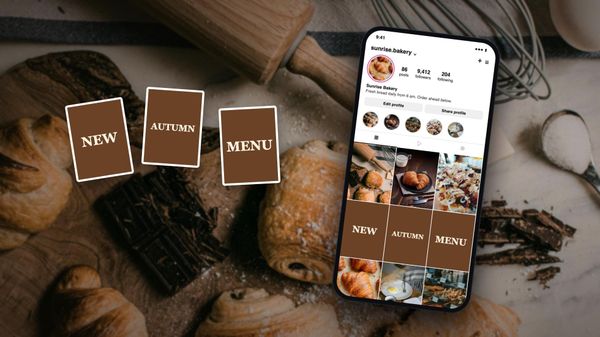
A grid post is one artwork split into tiles. When the tiles are posted in the right order, the profile shows the whole work across several rows. If you are new to it, this explainer on what an Instagram grid is covers the sizes, and the 3x3 grid guide shows the posting order.
For an artist, a grid does three things a single post cannot:
- It shows scale, because the work fills the screen.
- It shows detail, because every tile is also a close up in the feed.
- It turns the top of the profile into an exhibition wall, not a stream.
To split a work without guesswork, Circleboom's Instagram Grid Maker cuts your image into 3x3 or 3x4 tiles for free and previews them on a mock profile. When you want every tile posted in the right order, the Instagram scheduler takes over, with 90 days free to try it.
Between series, a row of three tiles works like a doorway between rooms. These Instagram feed divider ideas show how to mark where one series ends and the next begins.
Step 5: Show the work at human scale
A painting can look the same size as a postage stamp on a phone. Collectors want to know how big it really is.
- Post one photo of the work on a wall, ideally with a chair, a sofa or a person for scale.
- Use a carousel: full work first, then two or three details, then the work in a room.
- Add a short Reel of the process. Studio footage builds trust that a finished image alone cannot.
A ceramicist can show a vase on a shelf next to books. A muralist can post a wide shot with a person walking past. The viewer instantly understands what they would be buying.
Step 6: Post on a schedule, not on a mood
Collectors and galleries look for one signal above all: is this artist still working?
A profile that went quiet for four months answers that question badly. A steady rhythm, two or three posts a week, answers it well.
The problem is that artists finish work in bursts. Three paintings in one week, then nothing for a month while the next series develops.
The fix is to photograph in bursts and post in a rhythm. With Circleboom's Instagram scheduler you can schedule a month of posts to Instagram in one sitting, then go back to the studio. The scheduler also suggests the best time to post on Instagram for your own account, so your work goes up when your audience is actually there.
Why not Instagram's own scheduling? It handles one post at a time and does not split or order grid tiles for you. Circleboom schedules whole grids in order, carousels, Reels and Stories, across your Instagram, Facebook Page and other accounts from one calendar, which matters when the same new series should reach every channel in the same week.
Step 7: Turn profile visits into sales
A beautiful profile that leads nowhere is a gallery without a front desk.
Give every visitor a next step:
- One link in bio that goes to available works or a commission form. This explainer on what link in bio means covers the options.
- Track where buyers come from. Add UTM tags to the link, for example
utm_source=instagram&utm_medium=bio&utm_campaign=autumn_series. Your website analytics will then show how many visits and inquiries came from Instagram. If UTM is new to you, start with what UTM means in social media. - Answer DMs like a gallery would. Price, size, medium, shipping, all in the first reply.
- Say what is available. A small "available" or "sold" note in captions tells collectors where they stand.
The return is concrete: more visits to your website, more commission requests and more sales you can trace back to the profile.
Instagram has been the art world's favorite platform for years. Back in 2020, the Hiscox Online Art Trade Report, based on a survey of 552 art buyers, found that 68% named Instagram as their preferred platform for art related purposes, up from 34% in 2015.
68% of art buyers named Instagram their preferred platform for art, double the 34% of 2015.
8 masterpieces, 8 grid lessons for artists
To show how a profile works as a wall, eight famous paintings were hung two ways: on a museum wall and as an Instagram grid on a demo art Instagram account. Each one teaches something you can use with your own work.
1. Girl with a Pearl Earring: let one face hold the wall

Vermeer, about 1665. Nine posts, one gaze.
Vermeer's painting is small in real life, about 44 by 39 cm, at the Mauritshuis in The Hague. On a grid it fills the whole first screen.
Lesson: a portrait or a strong central subject works best in a 3x3, with the face in the middle row. Portrait painters and illustrators can open their profile with one face that looks straight at the visitor.
2. The Starry Night: wide work needs two rows
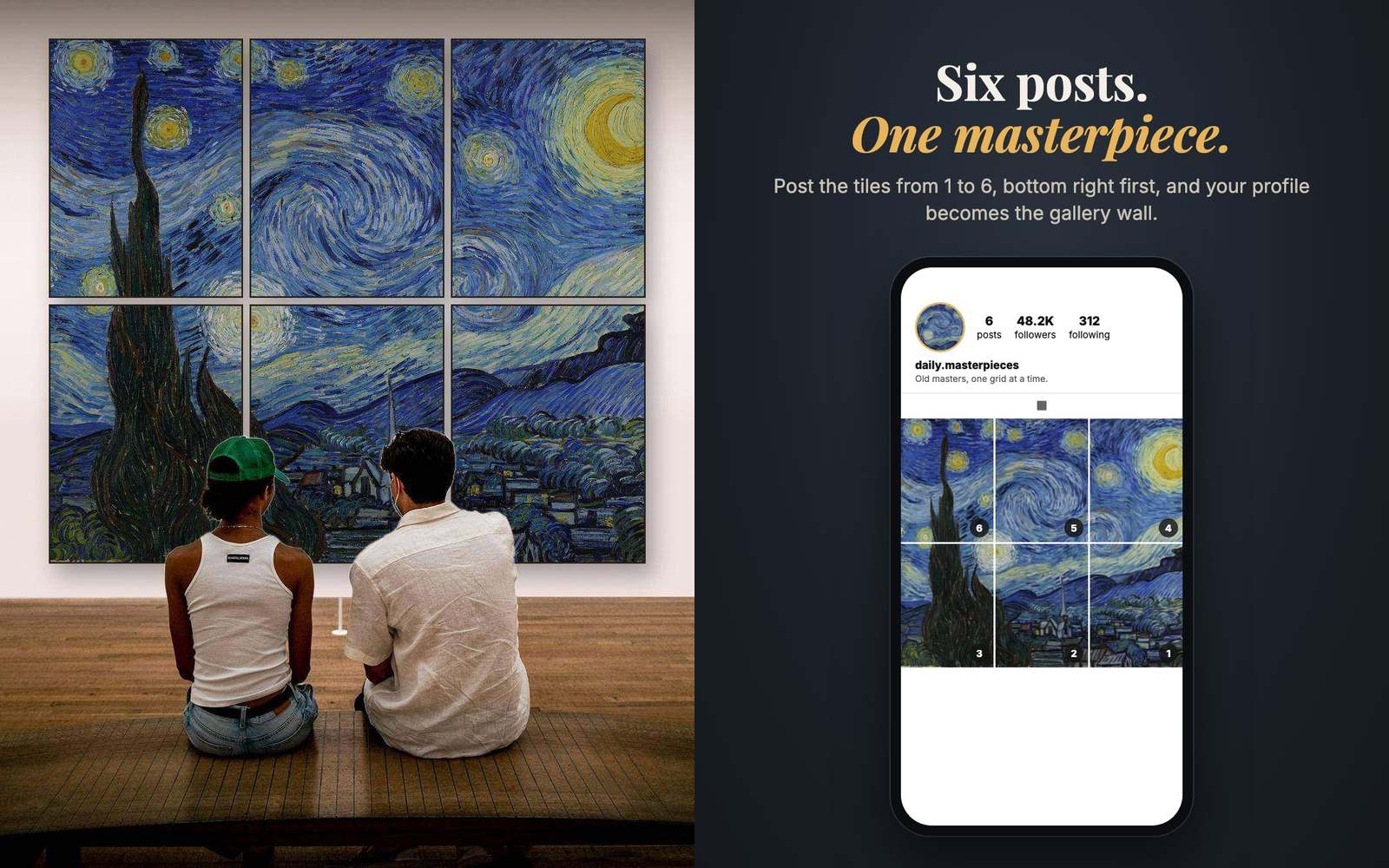
Van Gogh, 1889. A wide sky across two rows.
A wide painting squeezed into a square grid gets cropped. Spread over two rows of three, the sky runs across the whole profile.
Lesson: match the grid to the shape of the work. Landscape painters and photographers lose the most when they force a wide image into a tall layout.
3. The Great Wave: put the drama on the seams
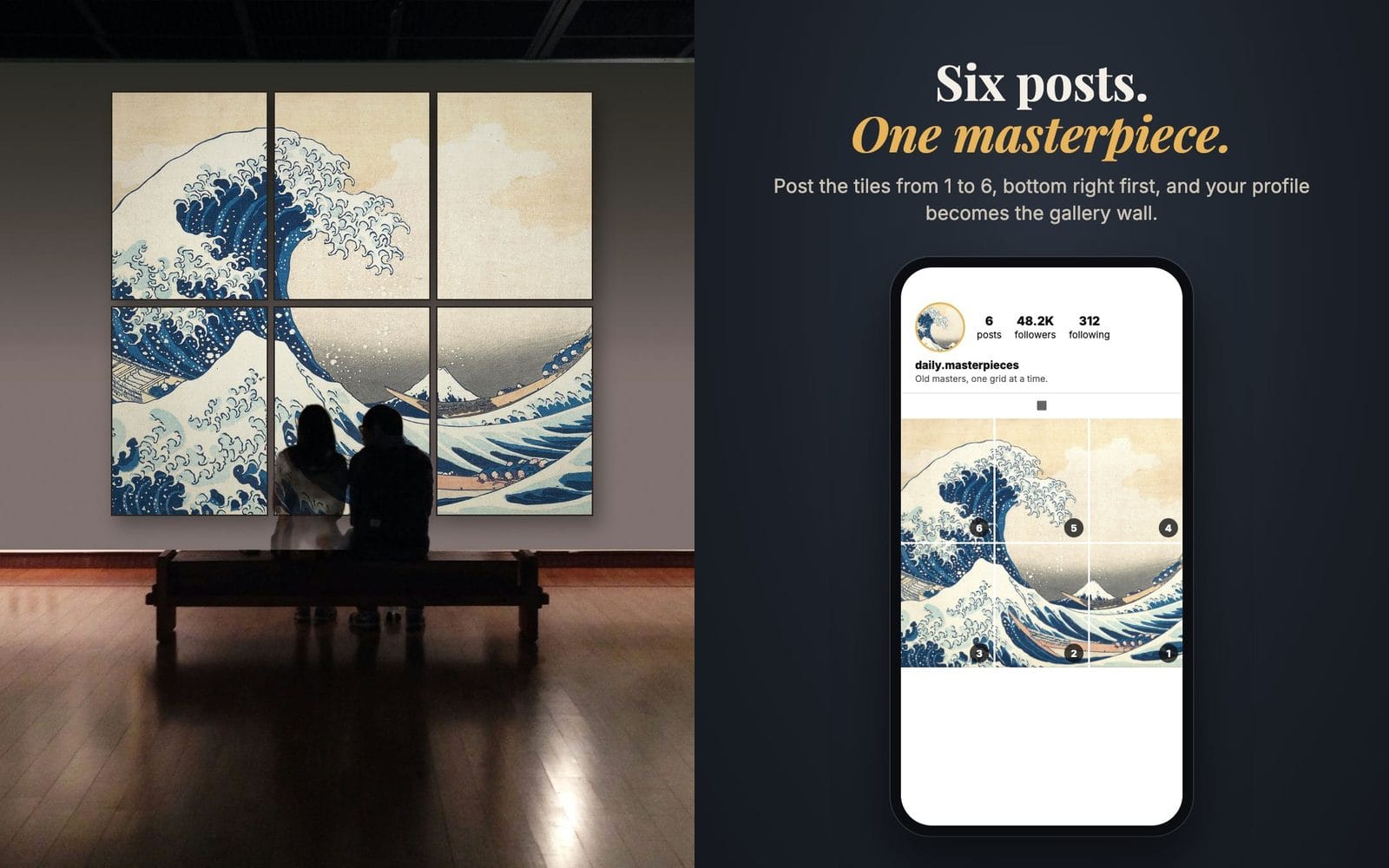
Hokusai, about 1831. The wave breaks across the tiles.
The wave crosses tile lines and still reads as one motion, and Mount Fuji sits in the center.
Lesson: strong diagonal movement survives the gaps between tiles. Printmakers and graphic artists can use that energy to pull the eye across the whole row.
4. The Scream: every tile must work alone
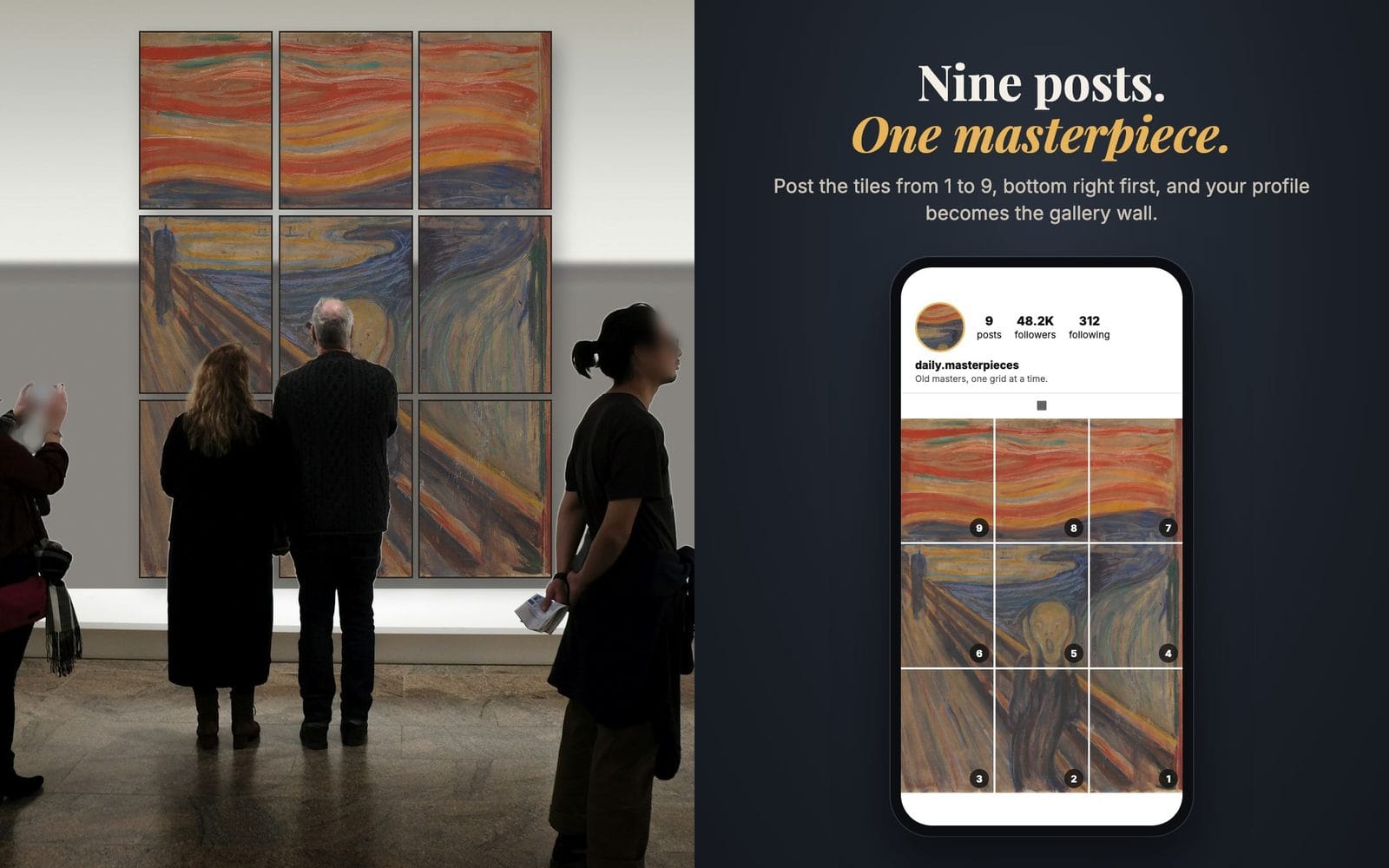
Munch, 1893. Each tile shows up separately in the feed.
In the home feed, followers see one tile at a time, not the whole grid. The orange sky tile alone has to make someone stop.
Lesson: check each tile as a single post before you publish. A tile that is only empty background will look like a mistake in the feed.
5. The Kiss: gold pulls the eye

Klimt, 1907 to 1908. Pattern and gold read even at thumbnail size.
At thumbnail size, detail disappears but color and pattern stay.
Lesson: works with a dominant color hold a grid together. Textile artists, pattern designers and abstract painters can build whole rows from one palette.
6. Sunflowers: one color family per series
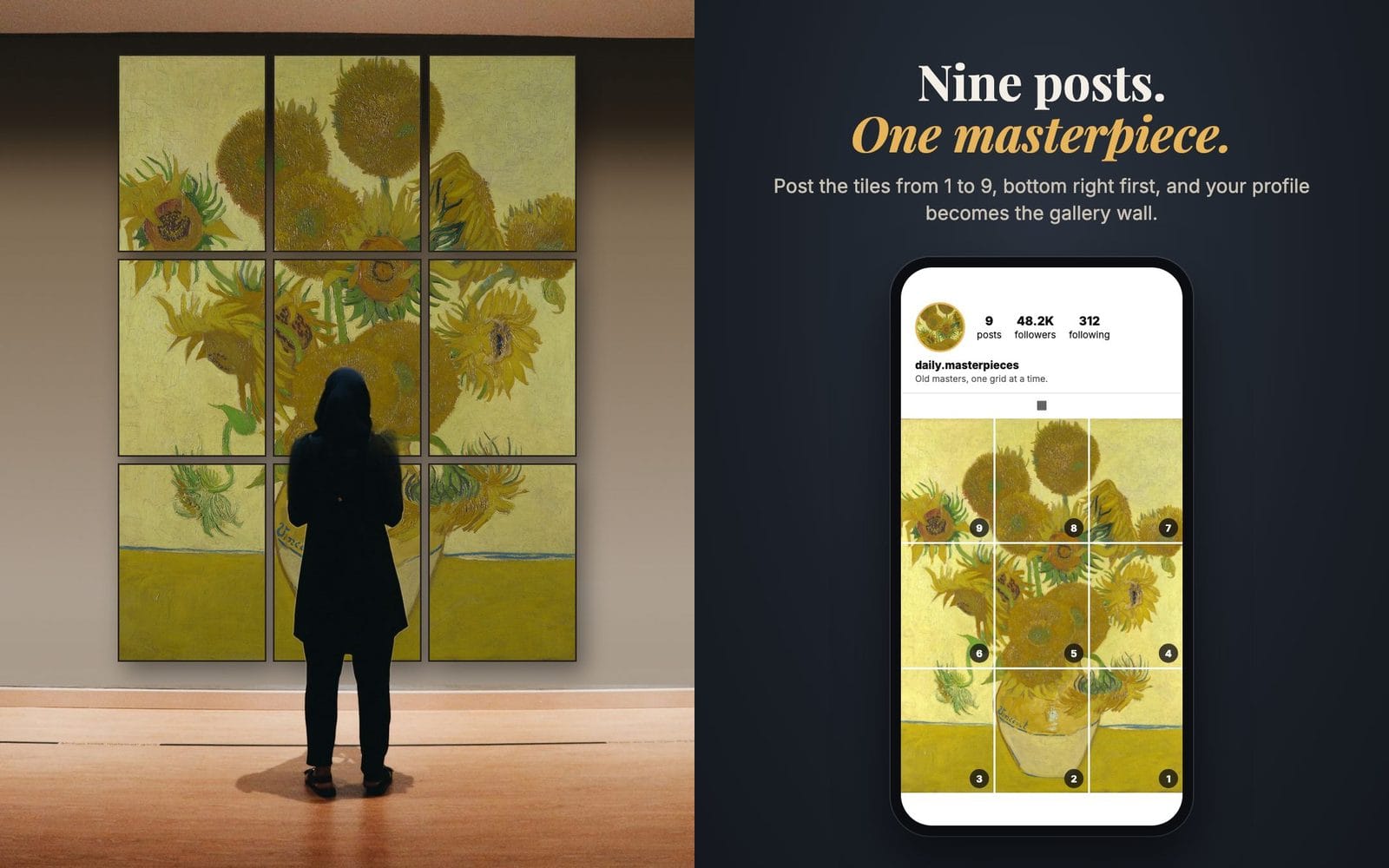
Van Gogh, 1888. One yellow carries all nine tiles.
Van Gogh painted several versions of Sunflowers. Hung together, they read as one series, which is exactly what a gallerist wants to see.
Lesson: keep each series in its own color family on the grid, so a visitor can see where one body of work starts and ends.
7. The Birth of Venus: put the hero in the center tile
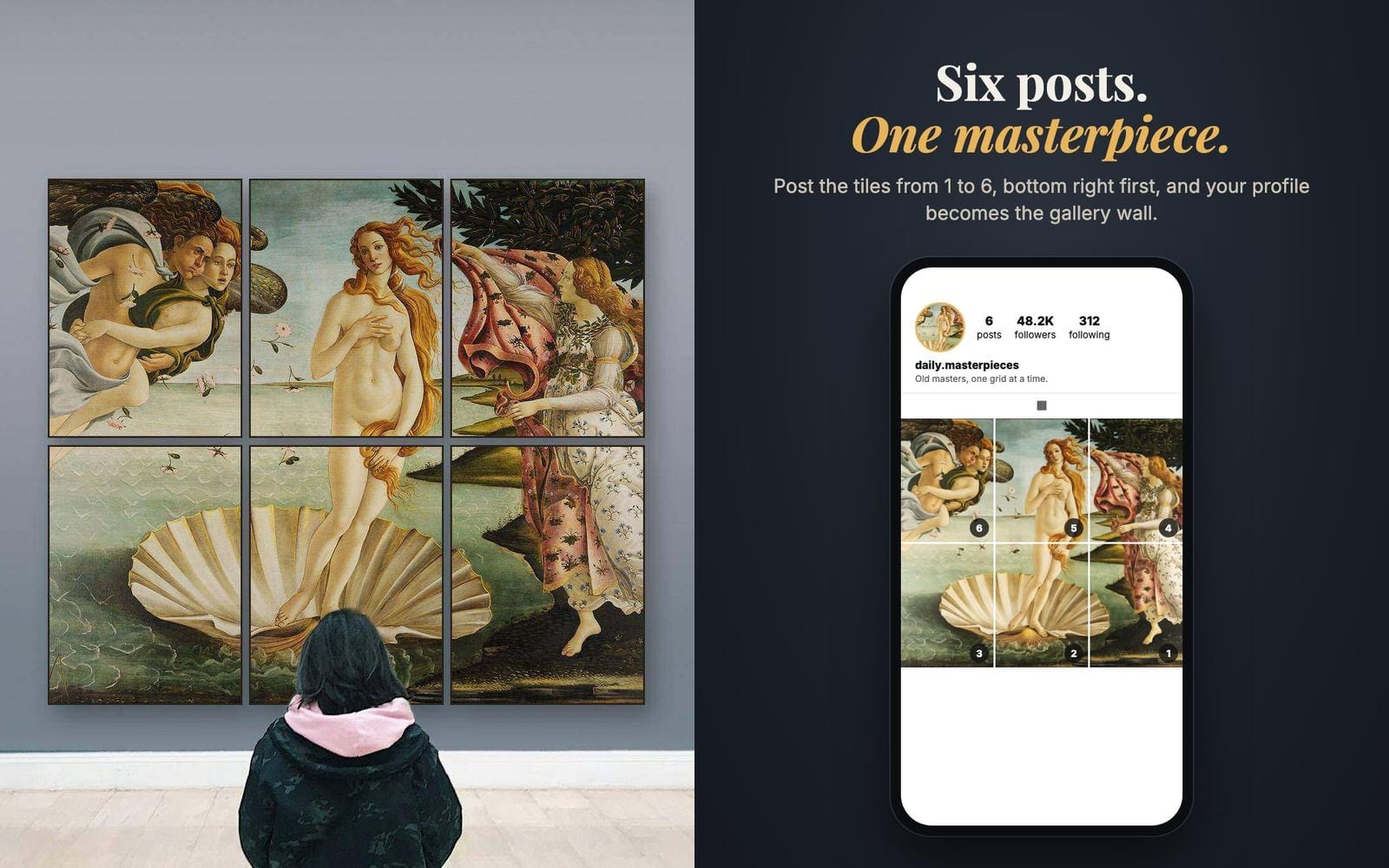
Botticelli, about 1485. Venus stands in the middle of the profile.
The center of the grid is where the eye lands first. Botticelli already put Venus there.
Lesson: before you split a work, check what lands in the middle tile. If it is a blank sky, crop the image until the subject sits in the center.
8. The Night Watch: big scenes need the full width

Rembrandt, 1642. A whole company marches across two rows.
The Night Watch is almost 4.4 meters wide in the Rijksmuseum. On a phone, it only works when it uses the full width of the profile.
Lesson: crowded scenes and murals need the widest layout you can give them. Muralists and illustrators of large scenes should show the whole work first, then the details in a carousel.
Do the math: one month of posting
Say a painter finishes four works a month.
- Each work becomes a grid of 9 tiles: 36 posts.
- Each work also gets one carousel with details and a room shot: 4 posts.
- One studio Reel a week: 4 posts.
That is 44 posts a month, from just four finished pieces.
Posted by hand, each tile takes about two minutes to upload, caption and place in the right order, so the grids alone take over an hour, and one missed tile breaks the picture. Scheduled in one session, the whole month takes about 30 minutes, and the tiles go out in order.
That is roughly an extra afternoon in the studio every month.
Mistakes that empty the room
These are the patterns that make artists on Instagram look unfocused or inactive at first glance.
- Posting everything. A gallery does not hang every sketch. Archive weak posts.
- No series. Ten styles in twelve posts reads as "still searching."
- Long silences. Four months without a post reads as "stopped working."
- No price path. "DM for price" with no answer for three days loses the buyer.
- Hidden work. If your best piece is 60 posts down, pin it.
FAQ
Is Instagram good for artists?
Yes. Instagram is where many collectors, gallerists and clients look first, and the 2025 Art Basel and UBS survey found that 51% of high net worth collectors had bought art through Instagram. The key is to treat the profile as a curated portfolio, not a diary.
How do artists get noticed on Instagram?
Artists get noticed by posting a consistent body of work, on a steady schedule, with a clear profile that explains what they make. Grids, carousels with details and short process Reels show the work better than single photos. Tag shows, fairs and venues so visitors can find you from there.
What should an artist put on their Instagram profile?
An artist Instagram profile should put the strongest current series at the top, pin the best row, and write a bio that says who you are, what you make, where you work and how to buy or commission. Use Highlights as rooms: available works, commissions, studio and press.
How do I sell art on Instagram?
Make it easy to buy: one link in bio to available works, clear prices or a fast DM reply, and a note on what is sold. Track the link with UTM tags so you can see which posts bring visits and inquiries. Show the work at real scale so buyers know what they are getting.
Should artists post grid posts on Instagram?
Grid posts are one of the best ways for artists to show scale and detail at the same time, because one artwork fills several rows of the profile. Post the tiles in the right order with nothing in between, or schedule them in order with a tool like Circleboom's Instagram Grid Maker.
How often should an artist post on Instagram?
Two or three times a week is a realistic rhythm for most artists. Consistency matters more than volume, because a long silence makes the profile look inactive to galleries and collectors. Photograph in bursts and schedule the posts ahead.
Your work deserves a wall.
On Instagram, the wall is your grid, and it is open to every gallerist, curator and collector who hears your name.
The Mona Lisa got a wall. You got a grid. Hang it like it matters.
Split your next artwork into grid tiles and schedule every tile in the right order with Circleboom's Instagram Grid Maker:
https://circleboom.com/social-media-scheduler/instagram-post-scheduler/instagram-grid-maker