A fake Twitter account checker answers one question quickly: does this X profile behave like a real person, or like a manufactured shell?
The answer changes what you do next, whether that account just followed you, replied to your post, or pitched you a partnership.
How do you tell if a Twitter account is fake?
Run the username through a checker that reads the account's public signals instead of guessing from the avatar and bio. Circleboom screens a single X username and returns a plain-language verdict on whether the profile shows fake account characteristics, using official API access.
→ fake Twitter account checker
What a fake Twitter account checker actually reads
A fake Twitter account checker reads the public signals attached to a username and converts them into a verdict.
It is not reading minds or private data. It is reading the traces that a real, lived-in account leaves behind and a manufactured one usually does not.
Circleboom's checker evaluates a short list of observable things:
- Profile completeness: the bio, avatar, header, and links a real owner tends to fill in.
- Account age: how long that username has existed on X.
- Follower and following structure: the shape of the account's connections.
- Activity level: whether the account posts, or simply exists.
- Username patterns and posting behavior: the machine-generated tells.
No single item on that list settles anything.
A brand-new account with a blank header is not automatically fake, and a five-year-old account is not automatically genuine.
The verdict comes from how those signals stack together. That stacking is the judgment most people cannot make reliably by scrolling a profile for ten seconds.
For the manual version of the same reasoning, 4 surefire ways to identify fake Twitter accounts walks through the signals one at a time.
The checker is doing pattern recognition at speed, not detective work.
Why a quick eyeball check misses the convincing fakes
The fakes that matter are the ones built to survive a glance.
A stolen headshot, a plausible bio, a handful of reposted opinions, and a follower count in the low thousands will pass most people's instinct check, because instinct is calibrated on the lazy fakes with egg avatars and eight followers.
X treats this kind of manufactured account as a policy problem in its own right, and its platform manipulation and spam policy describes the behaviors it prohibits.
Enforcement is real, but it runs on X's timeline, not yours. Between the moment a fake account lands in your notifications and the moment the platform acts, the decision about whether to engage is still yours to make.
That gap is where a Twitter fake profile check earns its place. It replaces a gut call with a repeatable one.
The stakes scale with what you are about to do.
Following back a fake costs you almost nothing. Sending a sponsorship brief, a discount code, or a DM with a link costs considerably more.
The piece on how to check if someone's Twitter followers are fake or real covers the same instinct problem from the audience-quality side.
How to use a fake Twitter account checker, step by step
Watch the lookup run end to end: this walkthrough shows a username going into the checker and the verdict coming back.
https://www.youtube.com/watch?v=JoabgUfgiTc
To check whether an X account is fake, enter its username into Circleboom's checker and read the verdict it returns against what you already know about the account. The lookup takes one field and one click. The judgment that follows takes a little context, which is why the sequence below splits into two phases.
Open the checker and enter the username
- Log in to Circleboom Twitter and connect your X account with official OAuth.

- Open the Essential Toolbox menu, where the free Circleboom checkers sit for logged-in users.
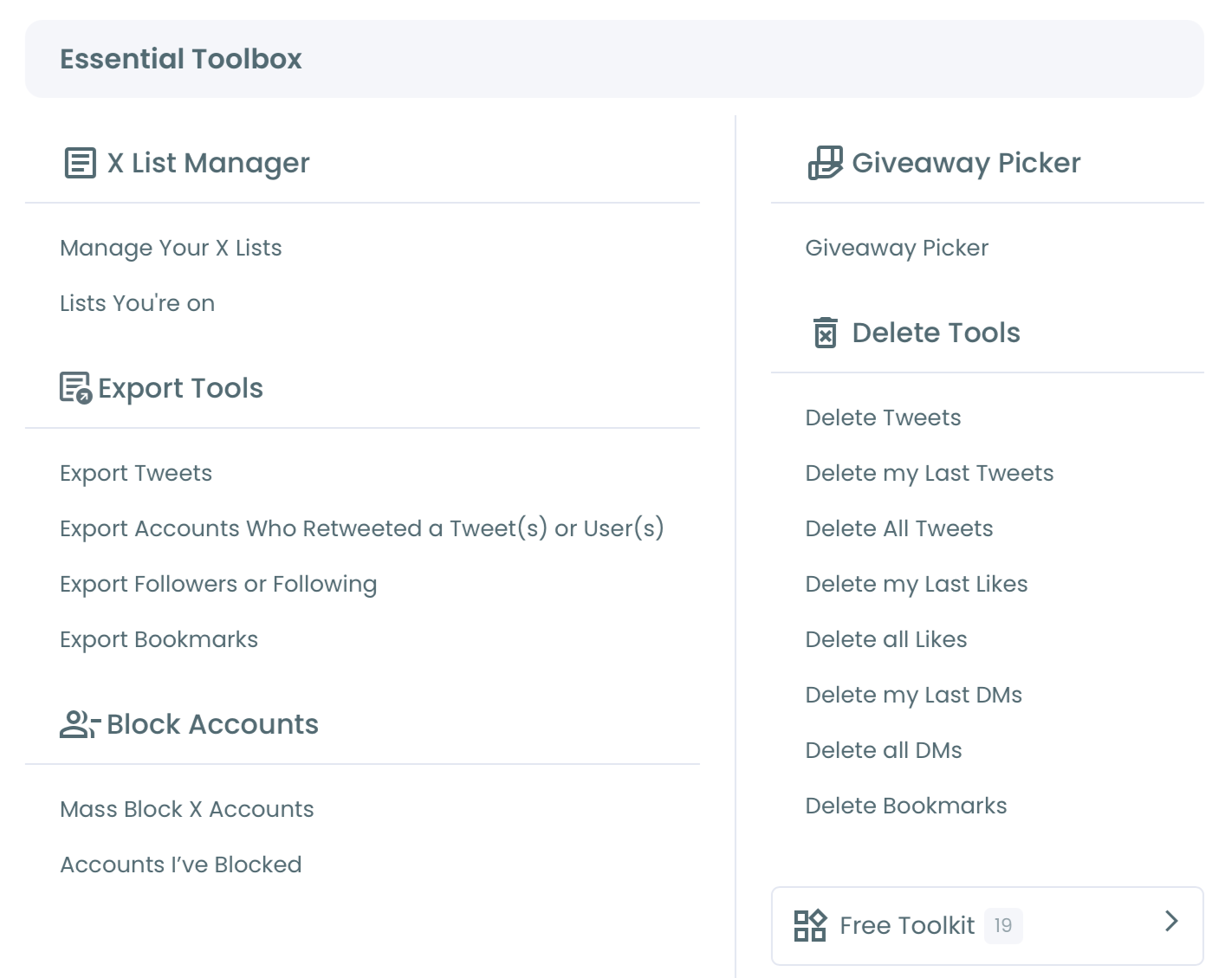
- Type the username into the input field. The format accepts letters, numbers, and underscore only, and the interface supplies the @ prefix for you.
- Click Search and let Circleboom evaluate the account's public signals.
Read the verdict, then weigh it against context
- Read the verdict line that appears below the search field. It arrives as a plain sentence with a status icon, not a percentage you have to interpret.
- Compare the verdict against the account's own history. A clean verdict on an account that has never posted still deserves a second look, and a flagged verdict on a dormant account may reflect inactivity rather than fraud.
- Decide the action. Keep, ignore, block, remove as a follower, or investigate further before you let the account into any workflow.
That order works because it separates the measurement from the decision.
The lookup gives you an observable, repeatable read on the account; the context step is where your own knowledge of the conversation, the niche, and the timing does the rest.
Reversing the two, deciding first and checking after, is how people talk themselves into engaging with an account they already suspected.
At a glance: log in, open Essential Toolbox, enter the username, click Search, read the verdict, apply context, act.
What the verdict proves, and what it does not
The verdict is a practical signal, not a legal finding. Circleboom states the result directly, in the shape of "This Twitter / X account isn't a fake profile," because a plain sentence is easier to act on than a confidence score that invites you to argue with it.
What it cannot do is prove identity.
A real person can run a sparse, odd-looking account. A well-funded operation can run a full-looking one.
The checker tells you which side of the pattern line an account falls on, and it does that consistently, which is more than a scroll through the profile will give you.
Treat the result as evidence, not as a verdict you have to obey.
Fakery and automation are also two different problems wearing similar clothes. An account can be operated by a real human and still be a fake identity, and an account can be genuine and still be automated.
Running the Twitter bot checker alongside the fake check covers both angles, which is why Circleboom keeps them as separate lookups rather than one blended score.
Circleboom is an official X Enterprise Developer company, so every lookup runs on sanctioned access rather than scraping. Your account is never asked to route around a platform rule to get an answer about someone else's account.
What the five signals look like on a real account
Reading the signal list in the abstract is one thing. Watching it behave on a live account is what makes the verdict believable, so it helps to know roughly what each one contributes.
Profile completeness is the cheapest signal to fake and the most commonly faked. A stolen headshot and a two-line bio cost nothing. What is harder to manufacture is coherence: a bio, a pinned post, a link, and a posting history that all describe the same person doing the same thing.
Account age is the signal fakers cannot buy quickly. Age alone proves nothing, since dormant accounts get bought and repurposed, but age combined with a continuous posting record is one of the strongest genuine-account markers available in public data.
Follower and following structure is where manufactured accounts get caught most often. Real accounts accumulate connections unevenly over time. A profile following four thousand accounts while being followed by ninety, with almost no overlap between the two lists, is describing a growth tactic rather than a person.
Activity level separates the account that exists from the account that lives. Posting cadence, reply behavior, and gaps in the timeline all read differently on an operated account than on a parked one.
Username patterns and posting behavior catch the batch-created ones. Handles with long random digit tails, near-identical bios across a cluster, and posting rhythms that never vary all point to the same origin.
How the five signals combine into one verdict
The checker does not average the signals. It looks for the combinations that only manufactured accounts produce, which is why a single odd reading rarely moves the result on its own.
An account can be young and still read clean if its posting record is continuous and its connections grew unevenly. An account can be old and still read as fake if its history restarts abruptly with a new name, a new bio, and a burst of replies aimed at strangers.
Run those five through a fake profile check on X and the value is not that any one of them is decisive. It is that the checker weighs all five in the same way every time, on every account you feed it, without getting tired or generous at the end of a long day.
What to do after a flagged verdict
A flagged verdict is a prompt, not an instruction.
Your options fall along a short scale, and picking the right one depends mostly on what the account has actually done to you.
Ignore it when the account has done nothing beyond following you. A fake follower that never interacts costs you a small distortion in your follower count and nothing else.
Remove it as a follower when your follower quality matters to you, to a sponsor, or to your own reporting. This clears the account from your list without escalating anything.
Block it when the account has replied, quoted, or messaged you in a way that reads like a scam attempt or a coordinated pile-on. Blocking is the right tool when interaction is the problem.
Report it when the behavior looks like a policy violation rather than an inactive shell. The platform handles the repeat cases better than any individual block ever will.
The one option worth avoiding is the middle path, where you decide the account is probably fake and engage with it anyway because the reply was flattering. That is the exact scenario the check exists to prevent.
Keep a light record of what you flagged and what you did about it.
A pattern across ten flagged accounts tells you something a single lookup cannot: whether you are being targeted by a campaign, or simply picking up the ordinary background noise every growing account collects.
Where a single account check fits in a wider X cleanup
One lookup answers one question.
Most people who ask it are actually working on a bigger problem: an audience that has drifted, a follower list padded with accounts that will never read anything, or a following list that has quietly filled with noise.
Once you have checked the account in front of you, the natural next step is scale. A Twitter Follower Audit looks at the whole list rather than one username.
Then there is the mirror question. The Twitter Quality Score reads how your own account looks to everyone else running the same kind of check on you.
Why fake X accounts keep reappearing
There is a reason the problem never fully goes away. The economics of manufactured accounts are covered in why Twitter allows millions of scam accounts to operate. The short version is that supply keeps up with enforcement.
The cost side matters too. Fake followers distort your own analytics, dilute your engagement rate, and make every reach number you report slightly wrong.
The rundown on what happens if my Twitter followers are fake is worth reading before you decide the problem is cosmetic.
If you want the dedicated page for single-username lookups rather than the broader screening surface, the Fake Twitter Account Checker page covers it directly.
Your next move
Checking one suspicious account is a quick habit that saves a much longer conversation later. Here is the short version of what to do with it:
- Check any new follower you are about to engage with commercially.
- Check any account that opens with a link, an offer, or a partnership pitch.
- Check before you add someone to a list, a collaboration, or a giveaway pool.
- Re-check the flagged ones after a week, since dormant accounts sometimes wake up and confirm the read.
None of that requires a subscription decision or a long setup. It requires one field, one click, and the willingness to act on what comes back.
→ check a fake Twitter account
Common questions about fake Twitter account checks
Can I check an account without following it first?
Yes. The lookup runs on a username, not on a relationship, so you can check any public X account whether or not you follow it or it follows you.
Does the person I check find out?
No. Checking a username inside Circleboom is a read of public signals and produces no notification, no follow, and no interaction on the account you looked up.
Is the fake Twitter account checker free to use?
Yes. It is a free Circleboom Toolkit feature, and logged-in users reach it from the Essential Toolbox menu alongside the other free checkers. The dedicated Fake Twitter Account Checker page carries the same single-username lookup for people who arrive without connecting an account.
How often should I re-check an account?
Re-check when the account's behavior changes, not on a fixed calendar. A dormant account that suddenly starts replying to your posts is worth a second lookup even if it came back clean the first time.