
Charge for social media posts by pricing the whole workflow behind them, writing, design, scheduling, client approval and reporting, and then package that count as a per-post rate, a monthly retainer or a bundle. The model is a wrapper; the hours inside it decide whether the price is fair.
What this pricing guide gives you.1) The three pricing models and when each one fits a client.2) A line-by-line view of what a social media post price should cover, from writing to reporting.3) The tool costs, monthly planning and client reporting that most quotes leave out.
Circleboom Publish cuts the hours behind each line by sending one post to every client account across ten social media platforms and holding staff posts for approval. Set up client workspaces with post approval before you quote.
Three ways to price social media posts
There are three common ways to price social media work: per post, as a monthly retainer, or as a package. Each one can be fair or unfair, depending on whether the work behind it was counted.
- Per post: one price for each published post, simple to explain and easy to undercharge with, because the hidden work rarely scales with the post count.
- Monthly retainer: one fee for an agreed scope (a post count, platforms, approval rounds and a report), which suits ongoing clients.
- Package: a fixed bundle, such as setup plus a set number of posts per platform, which suits clients who want a clear menu.
Pick the model the client understands, then fill it with the hours you measured.
Which pricing model fits which client
The client's situation usually picks the model for you:
- A one-off launch or event: a package, with setup, a fixed post count and a set number of revision rounds.
- An ongoing small business: a monthly retainer, because the planning, approvals and report repeat every month.
- A trial with a new client: per post for the first month, so both sides see the real volume before committing.
Whichever you pick, write the scope into the quote: platforms, posts per platform, revision rounds and the reporting date. A scope the client can read is the best defense against a month that doubles in size without anyone agreeing to it.
I leave market-rate figures out of this guide on purpose. The ranges that circulate online come from vendors and agencies with their own pricing to defend, and none of them shows the work behind a single post.
A price built from your own workflow holds up in a negotiation; a borrowed range does not.
The client is comparing your quote against two alternatives: doing it in-house with a scheduler, or hiring a full agency. Your price has to show what they get beyond the tool. That is the first reason to price social media posts line by line rather than as one round number, and to show the client the approval workflow they are paying for.
What should a social media post price include?
A social media post price should include five lines of work. They are writing, design, scheduling, client approval and reporting.
Circleboom Publish is a multi-platform publishing suite that writes, schedules and queues posts for Instagram, Facebook, LinkedIn, Google Business Profile and six more networks from one composer. That changes the time behind several of those lines.
Here is the framework. Each line of a quote maps to the work and the time behind it:
| Line of the quote | The work behind it | The time behind it |
|---|---|---|
| Writing | Captions per platform, rewritten to fit each network's limits | Your measured time; the built in AI writer drafts, condenses and rephrases |
| Design | Images, carousels, video edits | Your measured time; Canva, Unsplash and the AI Carousel Generator sit inside the composer |
| Scheduling | Publishing to every client account at the audience's hours | 28 separate posts to 7 accounts take close to an hour natively, about 10 minutes as 4 sends |
| Client approval | Revision rounds and the final sign off | About 10 minutes per client in an approval queue, against an hour of back and forth |
| Reporting | Showing which posts and platforms brought traffic | Tagged links and post analytics, read once a month |
The scheduling and approval figures are the documented ones from Circleboom Publish. Writing and design have no universal number, because a carousel and a one-line update are different jobs, so measure your own for two weeks before quoting.
Writing time grows with each platform
Writing time also grows with the number of platforms, because each network has its own limits. A 500-character caption fits Facebook (5,000 characters), Instagram (2,200) and LinkedIn (1,300) as written, but not Bluesky (300), so one idea can mean two versions. Count that rewrite in the writing line, or condense once with the AI writer and send one version everywhere.
The checks a paid service carries
Part of what a client pays for is care about what their posts claim. The FTC's guide to advertising rules for small businesses says ads must be truthful and claims need support before they run. A manager who checks offers and claims before scheduling is doing work a self-serve tool does not do.
Revision rounds belong in the scope as a stated number, with extra rounds billed, since every round is time. When the five lines are visible, the price becomes something a client can read and agree to, including the review rounds that run through client approvals.
How much do your own tools cost per client?
Your tool cost per client is your monthly tool bill divided by your client count, and with a team the part that grows is seats and connected platforms. That share belongs in every quote.
Pricing models differ across tools: some charge per user, some per connected channel, some for both. In Circleboom's comparison at the time, a realistic small-team setup of 10 social accounts and 5 users with publishing access came to $58 a month on Circleboom Publish. It does not charge per social media platform, so adding a client's Pinterest or TikTok adds no platform fee, and teammates are added as user add-ons.
The AI writing cost matters too. Many freelancers pay for a separate chatbot subscription just for captions. In Circleboom Publish, the AI button inside every composer comes with the membership at no extra cost, and it rewrites text punchier, shorter or more positive on request.
If you are comparing AI assistants for social media management, count that subscription you no longer need as a saving you can keep as margin.
The per-client tool share
Here is the per-client arithmetic as an illustration. If that $58 monthly setup is shared by four clients, each quote carries about $14.50 of tool cost.
Plans cap how many accounts, teams and team members one login can hold, so a bigger roster can mean a bigger plan. Recheck the share each time you add a client, and check those counters before promising a client their own workspace.
For first drafts from a link or a block of text, the social media post generator lists an AI generator for each platform. Faster drafting does not mean you should charge less for the post; it means your writing line shrinks while your rate stays tied to the result.
What goes into the monthly content plan you quote for?
The monthly content plan is the post count per platform, the formats, the posting slots and the approval dates, all agreed before the month starts. It is the document your retainer or package actually sells.
A social media content calendar template is a good starting point for the plan itself. Inside Circleboom Publish, the Outbox calendar view works as the live version of it. Its week and month views filter by platform, account and Share Group, which makes a thin week or a neglected platform easy to spot before the client does.
A plan worth quoting names these items for the month:
- The number of posts per platform and the formats (single image, carousel, video).
- The posting slots, taken from each account's own best times.
- The dates drafts go to the client for approval.
- The date the monthly report arrives.
Posting slots are not guesswork. The Schedule window in Circleboom Publish suggests windows from each account's own followers' activity, and posting at a suggested time instead of a random one is tied to up to 300% more engagement. That is a line of value a client can see in the plan.
Batching the month ahead
Content gets prepared ahead in a batch and released on schedule. The composer's Queue drops each post into the next open recurring slot of every selected account, and with RSS feeds, the Queue and bulk scheduling, a month of posting takes about two hours to set up in Circleboom Publish.
That is the habit behind the batch social media content approach, and it is what keeps a retainer profitable.
Batching demo: a full set of posts prepared in one sitting and released across the month, the routine a monthly plan depends on.
How to charge for social media posts with a workflow you can measure
To answer the pricing question with your own numbers, set up one client in a team workspace, run their month through a single composer and time it. The four steps below are the whole publishing side of a retainer, from login to a scheduled month, and they produce the numbers your quote's scheduling and approval lines are built on.
- Log in to Circleboom Publish with the account that holds your clients' connected profiles.

- Open Create New Post on All Platforms and select every account of one client, or pick the client's saved Share Group in one click.
- Write the post once and check each network's preview, using the AI button to condense or rephrase the caption where a platform's limits are tighter.
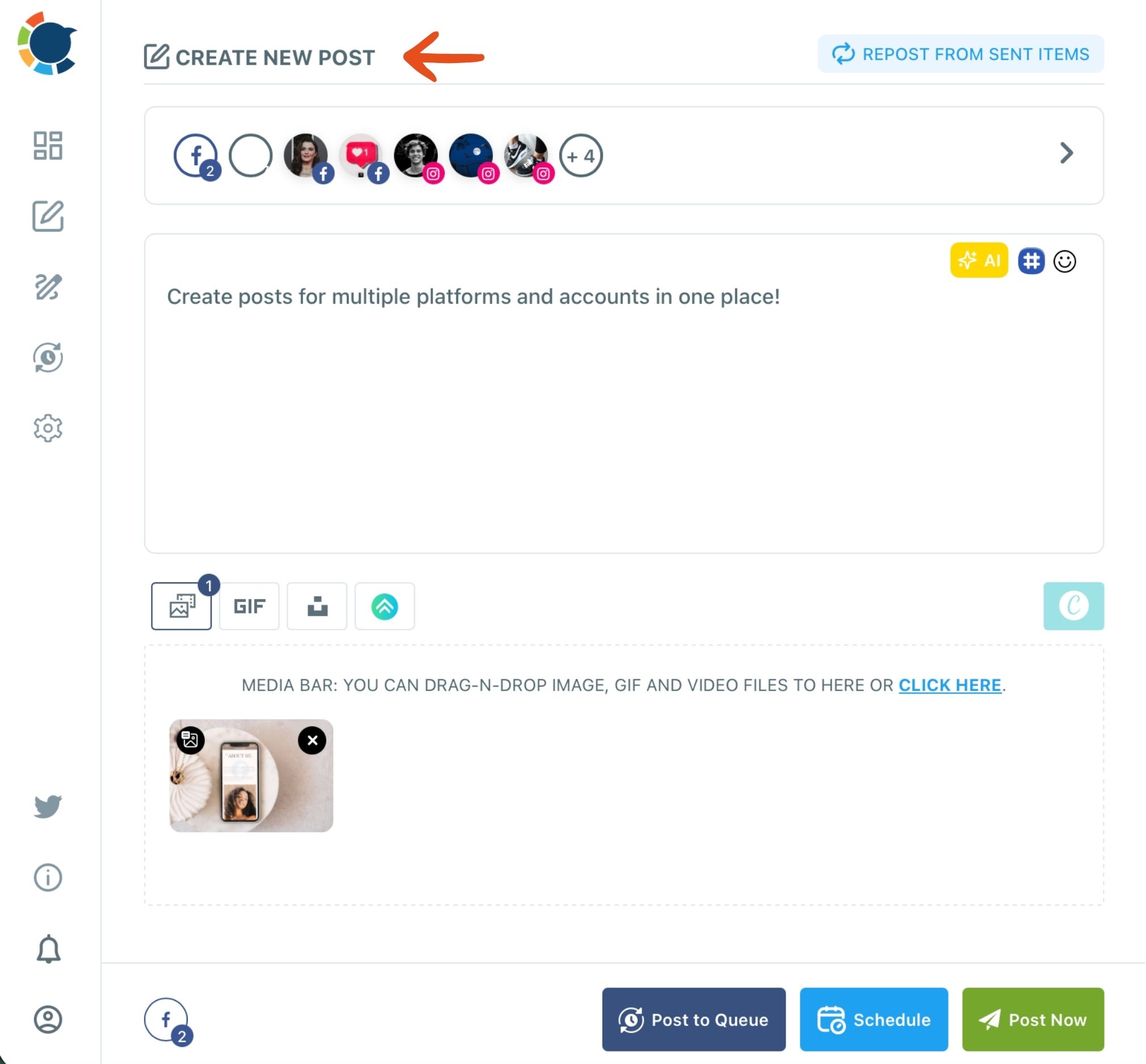
- Choose Schedule, Post to Queue or Post Now, then repeat for the rest of the month's posts and note the total time.
The order matters because selection comes before writing: when every client account is chosen first, one composing session serves all of them, and the time you record reflects the real cost of the scheduling line.
In short: log in, select the client's accounts, write and preview once, schedule the month, and time the whole run.
How do you show a client what their monthly fee bought?
You show what the fee bought with two numbers: how the posts performed on each platform, and how much traffic their links sent to the client's site. Reporting is a line of the quote, not a favor.
On-platform results come from social media post analytics, which covers engagement and content performance for each network Circleboom Publish supports.
Off-platform results come from tagged links. Before a post goes out, the UTM Link Builder in the composer tags the link with a source, medium and campaign, so Google Analytics later shows which platform and which post sent visitors and sales.
The UTM parameters that track social media success change what a monthly report can say. Instead of "posts went out," it says "this platform sent the buyers." That is the report that renews a retainer.
What a one-page client report covers
A one-page report covers what the client needs to judge the fee:
- The posts published per platform against the plan.
- The best and weakest posts by engagement.
- The traffic each platform sent, read from the tagged links.
- One change planned for next month, based on those numbers.
Keep it short. A client reads a report to decide whether the money worked, and four clear lines answer that faster than a slide deck.
When the client roster grows, the same setup repeats per client in its own workspace, so the hours do not grow at the same pace as the client count.
Summary: pricing social media posts in 2026
How much should I charge for social media posts? The answer comes down to counting before quoting. List the five lines (writing, design, scheduling, approval and reporting), add your tool cost per client, agree the monthly plan, and wrap the total in the model your client understands.
Circleboom Publish shortens the scheduling, approval and reporting lines, which is where most quotes lose their margin.
→ Bring client approvals and workspaces under one login
Social media pricing FAQ for 2026
How long does one social media post take to produce?
There is no universal figure, because writing and design time depend on the format, so time your own posts for two weeks. Publishing is the part you can shrink: four posts sent to seven accounts take about 10 minutes from one composer, against close to an hour account by account. The ways to reduce social media overwhelm cover the rest of the routine.
How do I get access to a client's accounts without their passwords?
The client grants access from the platform's own settings, for example from a Facebook Page or a Meta business portfolio, and you never hold their password. Inside Circleboom Publish, each client's accounts then sit in their own Team workspace, where every person has their own login and a User sees only the accounts assigned to them.
Should I charge more for video or Reels?
Yes, video usually carries more production time, so price it as its own line. Publishing it is not the costly part: video cross-posting sends one clip to Facebook, Instagram, TikTok and YouTube at once, within each platform's size limits.