
The dashboard was open on a second monitor when the question came in. The cleanup job had already processed 84 of 312 candidate posts, and the engagement-floor filter had been set at five total interactions over 90 days. The operator on the other side of the call was watching the running counter and asking, "If a post got two replies from a real customer, are we keeping it?"
The answer was visible in the filter. A post with a real reply from a customer would not have crossed the floor unless every other signal was also zero, and the preview list confirmed it. Twelve minutes later, the job finished, the account's rolling engagement average had moved up by 7 percent, and the timeline read like an account that had been edited with intent.
An auto-delete workflow for low-performing X posts works when the engagement floor is set against a long enough window, the candidate list is reviewed before the queue runs, and the deletions execute through the official X Enterprise APIs at a pace the platform sanctions. The Circleboom workflow produces an engagement-sorted candidate list, a reviewable queue you can edit before execution, and an account where the surviving posts represent the operator's current voice. → Run the auto-delete workflow on low-engagement posts
Why a Low-Performance Cleanup Lifts the Whole Account
The reason a careful cleanup of low-engagement posts moves the needle is that the X recommendation surface reads your account at the aggregate level. A profile whose median post earns 12 interactions reads differently than a profile whose median post earns three, even when the absolute totals look similar from the outside. The mean is dragged by the long tail of posts that earned nothing, and the long tail is what the algorithm sees when it decides how aggressively to surface your next post.
The fastest way to move the median is to remove the dead weight. That is not a controversial proposition once you sit with the math for a minute. A 1,200-post account where 400 posts earned zero interactions is functionally a 800-post account from an engagement-distribution standpoint, and the 400 dead posts are quietly pulling the surfaced sample toward a lower-impression equilibrium.
Circleboom's piece on deleting old tweets to increase reach walks through the operator-side case for this and includes the engagement-distribution math that explains why the cleanup compounds. The piece is useful because it does not promise overnight transformation; it describes the second-month and third-month lift, which is what actually happens in practice.
What "Low-Performing" Should Actually Mean in the Filter
Setting the engagement floor loosely is what gets a good post deleted by mistake. A defensible definition uses three layered signals and applies them as a compound filter.
The first signal is total engagement over a fair window. A post that earned fewer than five total interactions (likes, replies, reposts, quotes combined) across the 90 days following publication has functionally not landed.
The second signal is impression-adjusted engagement rate. A post that earned 80 impressions and one like has a healthier rate than a post that earned 8,000 impressions and ten likes; the floor should be set as a percentage of impressions rather than a raw number when impression data is available.
The third signal is reply quality. A post with two replies from real customer accounts is worth more than a post with two replies from spam handles, and the filter should be able to read reply provenance before the deletion runs.
When all three signals confirm low performance, the post belongs in the queue. When even one signal pushes back, the post stays out of the queue for a manual look. The compound filter is what separates a cleanup that lifts the account from a cleanup that quietly loses something worth keeping.
Circleboom's piece on the old-tweet deleter pattern covers the operator playbook for setting the engagement floor and the popularity criteria, and the framing transfers cleanly to the auto-delete variant.
How to Auto-Delete Low-Performing X Posts Step by Step
The full workflow runs in two phases: the engagement audit, then the auto-delete queue. The first run takes about 20 to 35 minutes depending on archive size; subsequent runs are faster because the saved filter does most of the candidate-building work automatically.
Phase 1: Build the Engagement Audit
Log in to Circleboom Twitter
- Log in to Circleboom Twitter with the X account whose posts you want to audit. The login uses official OAuth, so the credentials never pass through Circleboom directly.

Open the Essential Toolbox menu
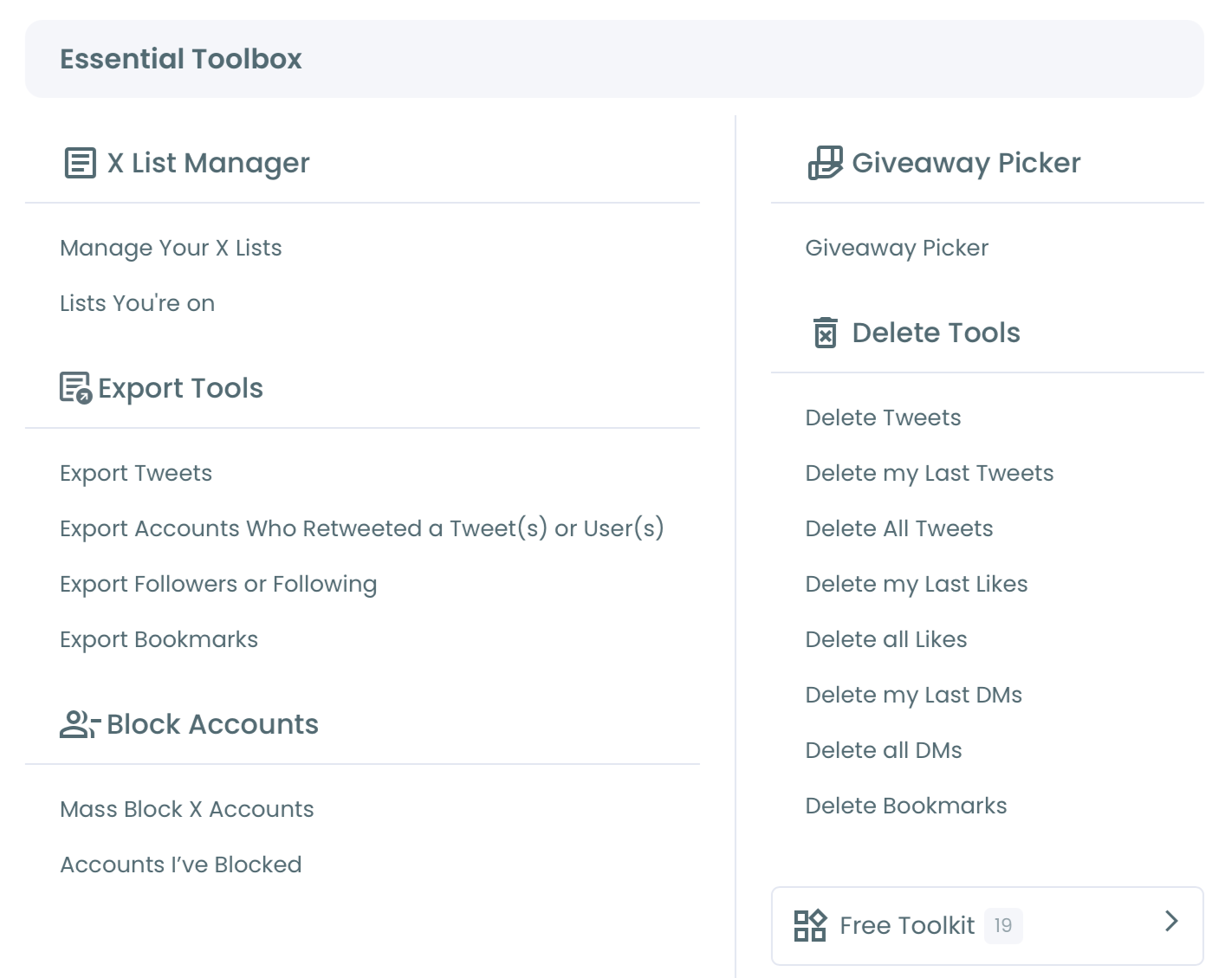
- Open the Essential Toolbox menu in the left navigation and find the Delete Tools section. This is the surface where the engagement-based cleanup lives.
Open Delete All Tweets and upload your X archive
- Open Delete All Tweets and upload your X archive file. The archive matters because the X API only exposes the most recent 3,200 posts; the archive unlocks the full history and lets the filter run against every post you have ever published, not just the recent slice.
Phase 2: Apply the Engagement Filter and Run the Queue
Set the engagement floor and review the candidate list
- Set the engagement floor to a combined-interaction threshold (likes plus replies plus reposts plus quotes) of fewer than five over a 90-day post-life window, exclude posts that have any reply from a verified or known-customer handle, and exclude pinned posts and posts that contain links to evergreen landing pages. Review the resulting candidate list row by row for at least the first 50 entries; manual review is the second filter and is the single most important step in the workflow.
Queue the reviewed list and start the auto-delete job
- Queue the reviewed list into the auto-delete job from the same screen. The tool reads the platform's published deletion limits and paces the requests automatically; the default cadence keeps the activity profile inside what X considers normal API usage.
Let the queue run and verify the next morning
- Let the queue run in the background and check the activity log the following morning. The log shows every deletion, every skipped post (already deleted, already removed by X, post protected by exclusion rule), and the running totals against the platform's caps.
The six-step sequence is the full workflow. The OAuth login earns sanctioned API access. The archive upload unlocks the full history. The engagement filter narrows the candidate pool, and the manual review removes the false positives that even a careful filter cannot catch on its own.
Video walkthrough: the engagement filter, the candidate review, and the auto-delete queue end-to-end.
What the Workflow Produces
The output is an account whose median engagement rises within the first 30 days because the long tail of zero-interaction posts is gone. The activity log records every deletion for audit purposes, the saved filter produces the next month's candidate list with a single click, and the surviving posts read as a coherent body of work rather than the cumulative output of every minor experiment you ever ran.
The Circleboom workflow uses the official X Enterprise API for both the candidate identification and the deletion execution, which is the structural reason the activity does not trigger platform enforcement. The X platform publishes its rate limits in the official limits documentation, and the tool respects those numbers natively.
Two adjacent surfaces extend the workflow. The bulk delete tweets landing covers the broader bulk-cleanup case for operators who want to run engagement cleanup alongside a date-range or keyword cleanup in the same session.
The delete tweets by keyword landing covers the targeted-content variant. The keyword variant is useful when specific topics or hashtags need to leave the timeline alongside the low-performers.
Related Circleboom reading on the auto-delete and engagement-cleanup theme.
- Delete low-engagement tweets on mobile fast, safe, and easy on the mobile-side variant of the same workflow.
- Auto delete all tweets on the scheduled auto-deletion pattern that complements the engagement filter.
- How to mass delete tweets based on popularity on the broader popularity-driven cleanup that pairs with this engagement-based variant.
Where the Account Goes Next
A first cleanup typically removes 25 to 40 percent of an active account's historical posts, and the engagement-rate lift is visible in the next 30-day window because the recommendation surface starts sampling from a stronger distribution. The second monthly run removes another 5 to 10 percent and catches the posts that aged out into the floor.
By the third run, the workflow is on a maintenance cadence: the engagement filter is calibrated to the account's actual performance distribution, the manual review takes 10 minutes instead of 30, and the deletions are running against the trailing 90-day window rather than the full archive. The account reads as one that publishes intentionally, and the algorithmic posture follows.
The compounding benefit is the part that surprises operators who try this for the first time. The median-engagement lift is real but modest. The compounding lift, where each month's cleanup reinforces the prior month's gains and the surfaced sample keeps improving, is the reason the workflow is worth running on a schedule. Run the auto-delete workflow on low-engagement posts and the dead weight stops dragging on the account average.
Still Wondering?
How many low-performing posts can I auto-delete in a single run?
The X API caps deletion requests, and the auto-delete tool respects those caps automatically. In practice, a single overnight run will process between 1,500 and 3,000 deletions depending on account age and rate-limit window. Larger backlogs are split into consecutive runs across multiple days, and the tool resumes from the queue position where the prior run stopped.
What if I accidentally delete a post I wanted to keep?
The activity log records every deletion with timestamp and post ID, but the deletion itself is permanent because X does not expose a server-side recovery endpoint for deleted posts. The protection against accidental deletion lives in the manual review step and in the exclusion rules (pinned posts, verified-reply posts, evergreen-link posts), which catch the obvious cases before the queue runs.
Will the cleanup trigger a platform warning or rate-limit lockout?
A rate-limited deletion run that uses sanctioned API endpoints reads as normal API activity to the platform's enforcement systems. The activity-pattern signals that trigger warnings are unsanctioned scraping, undifferentiated bulk activity from non-API sources, and request bursts that exceed published rate limits. None of those apply to a Circleboom run.
How long before the engagement-rate lift is visible in my analytics?
The first 30-day window after a cleanup shows the largest visible move because the surfaced sample shifts immediately when the long tail of zero-interaction posts is removed. The compounding lift over the second and third months is smaller per-month but more durable, and the curve flattens once the account is on a maintenance cadence and the cleanup is catching new low-performers as they age into the floor rather than processing a multi-year backlog.
Can I run the cleanup on replies as well as original posts?
The engagement filter applies to any post type the X archive exposes, which includes original posts, replies, quote posts, and reposts. Most operators run the first cleanup against original posts only, then add replies in the second run once the filter calibration is settled. Running replies and originals in the same pass works, but the candidate list is larger and the manual review takes longer.