
The batch was already running when the client messaged. We were forty accounts into a 200-account auto-unfollow queue against a list of dormant follows that had built up for three years, and the question on the other end was, "Are you sure this isn't going to flag the account?"
The answer was already visible in the run log. The pace was conservative, the API requests were sanctioned, and the activity filter had been narrow enough that nothing borderline made it into the queue. By the next morning, the timeline was already fresher, and the account had not received a single platform warning. That run has been the template for every auto-unfollow workflow I have set up since.
Auto-unfollowing inactive accounts works when you treat it as a two-stage process: a strict activity filter that protects valuable low-frequency accounts, then a rate-limited removal that respects the platform's published limits. The Circleboom workflow keeps both stages inside the official X Enterprise APIs so the account stays in good standing while the cleanup runs. The audit produces a reviewable inactivity list, a removal queue you control, and a cleaner timeline that holds week to week. → Start the auto-unfollow workflow
Why Auto-Unfollow Needs a Filter, Not a Sledgehammer
The fastest way to break an account is to point an unfollow script at a thousand accounts and let it run. The platform's anti-manipulation enforcement reads sudden, undifferentiated bulk activity as bot behavior, and the consequences range from temporary action limits to a permanent ban. The Circleboom workflow exists because the operators who need to clean a following list at scale also need to stay inside the rules.
The filter stage is where most of the safety lives. An inactive follow is not a uniformly defined category. Some accounts post once a quarter and are still useful. Others have been dormant for two years and contribute nothing to the timeline. The filter has to separate those two cases before the queue gets built, and the criteria that work are tenure, posting frequency over a long window, and last-activity date rather than a single recent-activity check.
Circleboom's piece on removing inactive Twitter accounts covers the practical criteria from the operator side. The piece is useful because it walks through the exact filter combinations that catch dormant accounts without sweeping up the low-frequency-but-valuable ones, and the math holds up against current X behavior.
The removal stage is then governed by X's published follow and unfollow limits, which cap the daily volume and the per-window pace. The auto-unfollow workflow respects those numbers natively, which is the structural reason it does not trigger enforcement.
What "Inactive" Should Actually Mean in the Filter
Defining "inactive" loosely is what gets useful accounts swept into the queue. A defensible definition uses three signals that have to all fire.
The first signal is last-tweet recency. An account whose last post is more than 180 days old is dormant for most operator purposes. The second signal is long-term posting frequency. An account averaging fewer than one post per quarter over the prior two years has functionally exited the platform, regardless of whether they checked in once last month.
The third signal is engagement footprint. An account with no replies, no quotes, and no likes in the prior 90 days is contributing nothing to the timeline even if a stray post slips through.
When all three signals fire, the account belongs in the queue. When only one or two fire, the account stays out and gets a manual review pass. The conservative threshold is what separates a clean cleanup from a regretted one.
Circleboom's piece on identifying and removing low-quality followers covers the audience-side variant of the same filter logic, which is useful background because the activity-signal math transfers cleanly to the following-side cleanup.
How to Auto-Unfollow Inactive Twitter Accounts Step by Step
The full workflow runs in two phases: the inactivity audit, then the auto-unfollow queue. Each phase has three actions. The first run takes about 25 to 40 minutes depending on following-list size; subsequent runs are faster because the filter settings are saved.
Phase 1: Build the Inactivity Audit
Log in to Circleboom Twitter
- Log in to Circleboom Twitter with the X account whose following list you want to audit. The login uses official OAuth, so the credentials never pass through Circleboom directly.
Open the Follower-Following menu
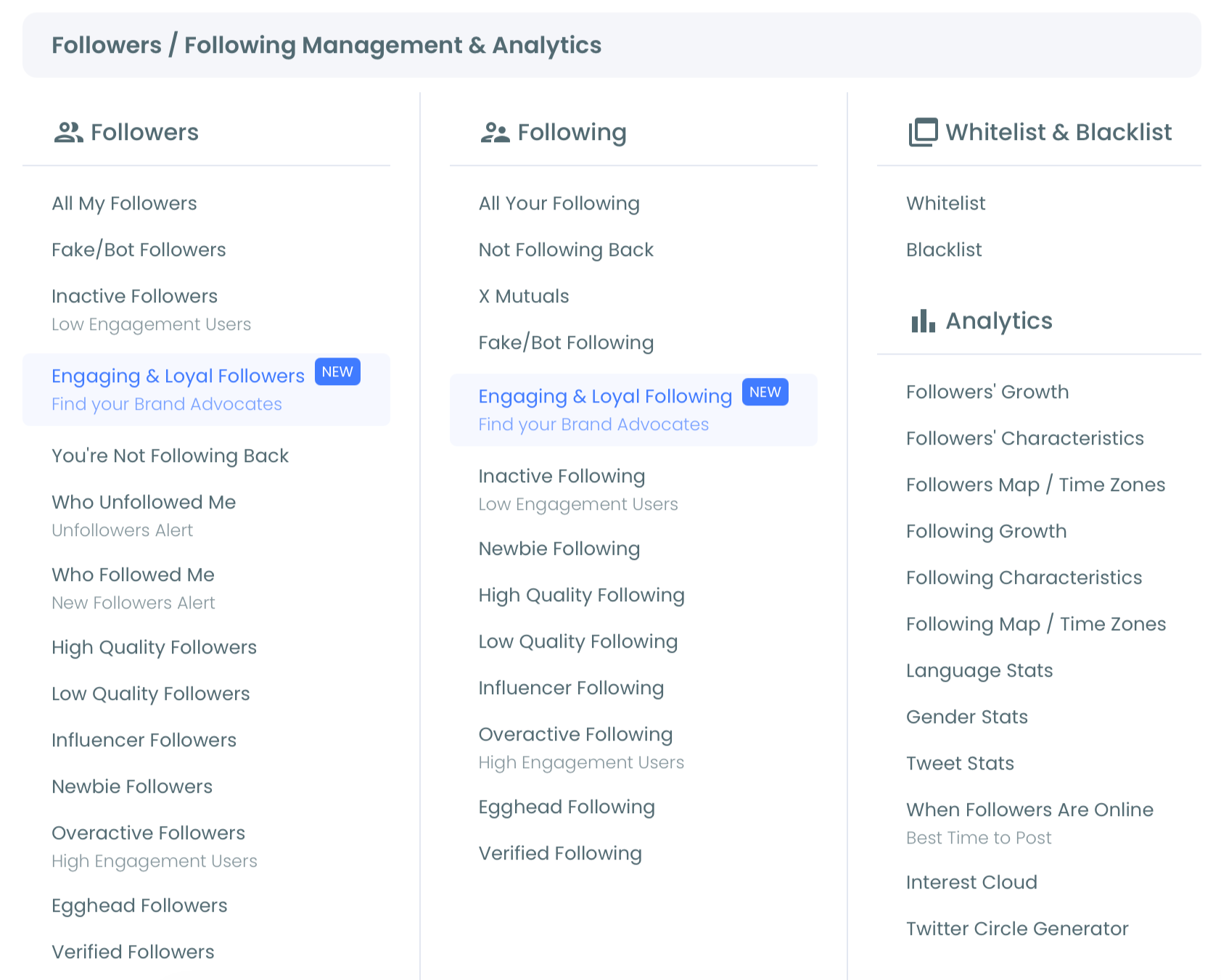
- Open the Follower-Following menu in the left navigation. This is the audience-management surface where the Inactive Following report lives.
Open the Inactive Following report and set the filter
- Open the Inactive Following report under the Following section. Set the activity filter to last-tweet recency of 180+ days, long-term posting frequency below 4 posts per year, and an engagement footprint of zero over 90 days. The report rebuilds against these settings and produces the candidate list for review.
Phase 2: Run the Auto-Unfollow Queue
Review the candidate list and remove false positives
- Review the candidate list row by row for the first 50 entries. Remove any account whose dormancy is misleading (industry experts who post once a quarter, archival accounts, holiday-driven seasonal posters). The manual review is the second filter and is the single most valuable step in the workflow.
Open the Auto-Unfollow tool and queue the reviewed list
- Open the Auto-Unfollow tool from the toolbox. Send the reviewed candidate list into the queue. The tool reads the platform's published limits and paces the removals automatically; the default cadence is 40 to 50 unfollows per batch and roughly 800 per day, which keeps the account inside sanctioned activity.
Let the queue run and check the log the next morning
- Let the queue run in the background and check the activity log the next morning. The log shows which accounts were removed, which were skipped (already unfollowed, blocked, account suspended), and the running totals against the daily caps. The next batch can be queued immediately if the cap was not reached.
The six-step sequence is the full workflow, and the two-phase split is what keeps it safe. The OAuth login earns sanctioned API access. The menu navigation loads the inactivity-detection surface. The filter narrows the candidate set, and the manual review removes the false positives. The auto-unfollow queue then runs at a pace the platform considers normal.
Video walkthrough: the Inactive Following report and the auto-unfollow queue end-to-end.
What the Workflow Produces
The output is a cleaner following list that holds week to week, an activity log showing every removal for audit purposes, and a saved filter that produces the next month's candidate list with a single click. The follower count is unaffected (auto-unfollow operates on outgoing follows only), and the timeline freshness improves immediately because the dormant accounts that were silently consuming feed slots are gone.
The Circleboom workflow uses the official X Enterprise Developer access for both the inactivity detection and the unfollow execution. The platform's enforcement on automated platform manipulation targets unsanctioned bulk activity, which is why the rate-limited workflow matters: the activity profile of a Circleboom auto-unfollow run is indistinguishable from a careful human cleanup at the API level.
One adjacent surface extends the workflow. The inactive Twitter accounts landing covers the dedicated inactivity-cleanup page that pairs with the auto-unfollow tool and gives a second entry point for the same audit.
Related Circleboom reading on the auto-unfollow and bulk-cleanup theme.
- How to auto-unfollow accounts not following back on Twitter on the not-following-back variant of the same workflow.
- How do I unfollow people automatically on X/Twitter on the broader automated-unfollow pattern.
- How to bulk unfollow on Twitter on the bulk-cleanup mechanics that complement the inactivity filter.
Why This Workflow Keeps the Account Safe
The reason this workflow holds where script-based mass unfollow gets accounts banned is that the activity profile matches what the platform considers normal. The filter stage narrows the queue to genuinely dormant accounts, and the manual review removes the false positives a pure algorithmic filter cannot catch.
The auto-unfollow tool then paces removals at the platform's published rates, runs through sanctioned API endpoints, and leaves an activity log the operator can audit.
The compounding benefit shows up after the second or third monthly run. The first run clears the accumulated dormancy of years. The second run catches the accounts that went silent in the prior month.
By the third run, the workflow is on a maintenance cadence, the filter settings are stable, and the following list reflects the operator's current interests rather than a decade of cumulative drift. Start the auto-unfollow workflow and the dormant accounts disappear on a schedule that respects the rules.
Still Wondering?
How many inactive accounts can I auto-unfollow in one day?
The platform's published unfollow limits cap the daily volume at roughly 800 actions per 24 hours, with a 50-per-15-minute pace within that. The auto-unfollow tool respects both numbers natively, so the practical answer is "queue as many as you want, and the tool will process up to the daily cap and resume the next day."
Will auto-unfollowing trigger a platform warning or ban?
A rate-limited, filter-driven auto-unfollow run looks like a careful human cleanup at the API level, which is what keeps it safe. The enforcement signals that trigger warnings are sudden undifferentiated bulk activity, unsanctioned automation tools, and follow/unfollow churn patterns. None of those apply to a Circleboom run.
What if I unfollow someone who turns out to still be valuable?
The activity log records every removal, so reversing a mistake is a one-action follow-back. The bigger protection is the manual review step in the workflow, which catches the obvious false positives before the queue runs. Operators who skip the review step are the ones who report regretted unfollows.
Can the workflow run on a schedule without me reviewing each time?
The auto-unfollow execution runs on a schedule. The filter and manual review steps do not, by design. Skipping the review is what surfaces the false positives, and the 10 minutes the review takes is the difference between a clean cleanup and a recovery effort.
Does auto-unfollow affect my follower count?
No. Auto-unfollow operates on outgoing follows only, which means the count of accounts you follow drops and the count of accounts following you is unchanged. Some of the accounts you unfollow may eventually unfollow back, but that is a downstream consequence, not a direct effect of the auto-unfollow run.