

A cringe tweet costs you nothing until someone finds it. Then it costs you a job screen, a partnership call, or an afternoon of quote posts you never asked for.
Cleaning them out sounds like a five-minute job, and it is not, because the posts you want gone are scattered across years of timeline instead of parked in one neat block.
What this guide gives you.A four-signal test that separates genuinely cringe posts from posts you simply do not remember.The one filter setting that stops a cleanup from eating your best-performing tweet.A repeatable ten-minute run that needs no archive upload.
Circleboom loads your last 3,200 posts from X, then lets you filter, preview and delete cringe tweets in bulk from a single table. Start with delete cringe tweets.
Why cringe tweets are harder to remove than old tweets
Old tweets are a date problem. Cringe tweets are a judgment problem, and the two need completely different tools.
If you want everything before 2022 gone, you sort by date and stop thinking.
Cringe does not sit still like that. It is the reply you fired off during an argument, the take you have since abandoned, the joke that landed differently three years later, the enthusiastic thread about a company that no longer exists.
Those posts are spread across the whole timeline, mixed in with content you still want.
X does not help here at all.
Its own how to delete a Post page states the limit in a single line: the platform provides no way to bulk-delete, and posts come down one at a time.
Native X gives you nothing beyond that. Everything else you have read about "Twitter's bulk delete" is describing a third-party tool.
I have watched people try to do this manually. They scroll, they get distracted reading their own posts from 2019, and they quit around post ninety with the worst offenders still live.
Manual review fails not because it is hard but because it is long.
Attention runs out before the timeline does.
Circleboom fixes the scale problem by pulling your recent Twitter posts into one filterable table, so you can clear your cringe tweet history on X by rule instead of by scroll.
Before you touch any of that, though, you need to know what you are actually looking for.
What actually makes a tweet cringe: the four-signal test
Most cleanup guides tell you to delete old posts. That is a blunt instrument, and it removes plenty of content worth keeping.
A tighter definition helps, and after enough cleanup runs a pattern shows up: cringe posts almost always carry at least one of four detectable signals.
Here is the test:
- A name or keyword you have moved on from. A former employer, an ex, a product you evangelized, a person you no longer want to be publicly associated with.
- A dead engagement floor. Nobody replied, nobody liked it, nobody saw it. Deleting it costs you nothing measurable.
- A window. A specific week or month you would rather not have documented, usually around a job change, a breakup, or an online argument.
- A post type. Replies and quote posts age worst, because they carry context that has since evaporated.
The reason this test matters is that all four of those signals map to a control Circleboom actually exposes.
Keyword, date range and like count are three separate filters.
Post type is a fourth, sitting in the same panel, which is how you catch the replies that carry none of the words you would think to search for.
A vague sense of embarrassment maps to nothing. "Delete replies mentioning that company, posted between March and June, under five likes" maps to four settings, and it runs in seconds.
That is the difference between a cleanup you finish and a cleanup you abandon.
Deciding which posts earn their place is its own question, and our breakdown of what to delete and what to keep works through it case by case.
How to delete cringe tweets from your Twitter, step by step
The flow below runs in two phases: load and protect first, then narrow and delete.
Video walkthrough: how the filter panel narrows 3,200 loaded posts down to the handful you actually want gone.
https://www.youtube.com/watch?v=fEyzaqtQKEY
Load your recent posts and protect the winners
- Log in to Circleboom Twitter and connect your X account.

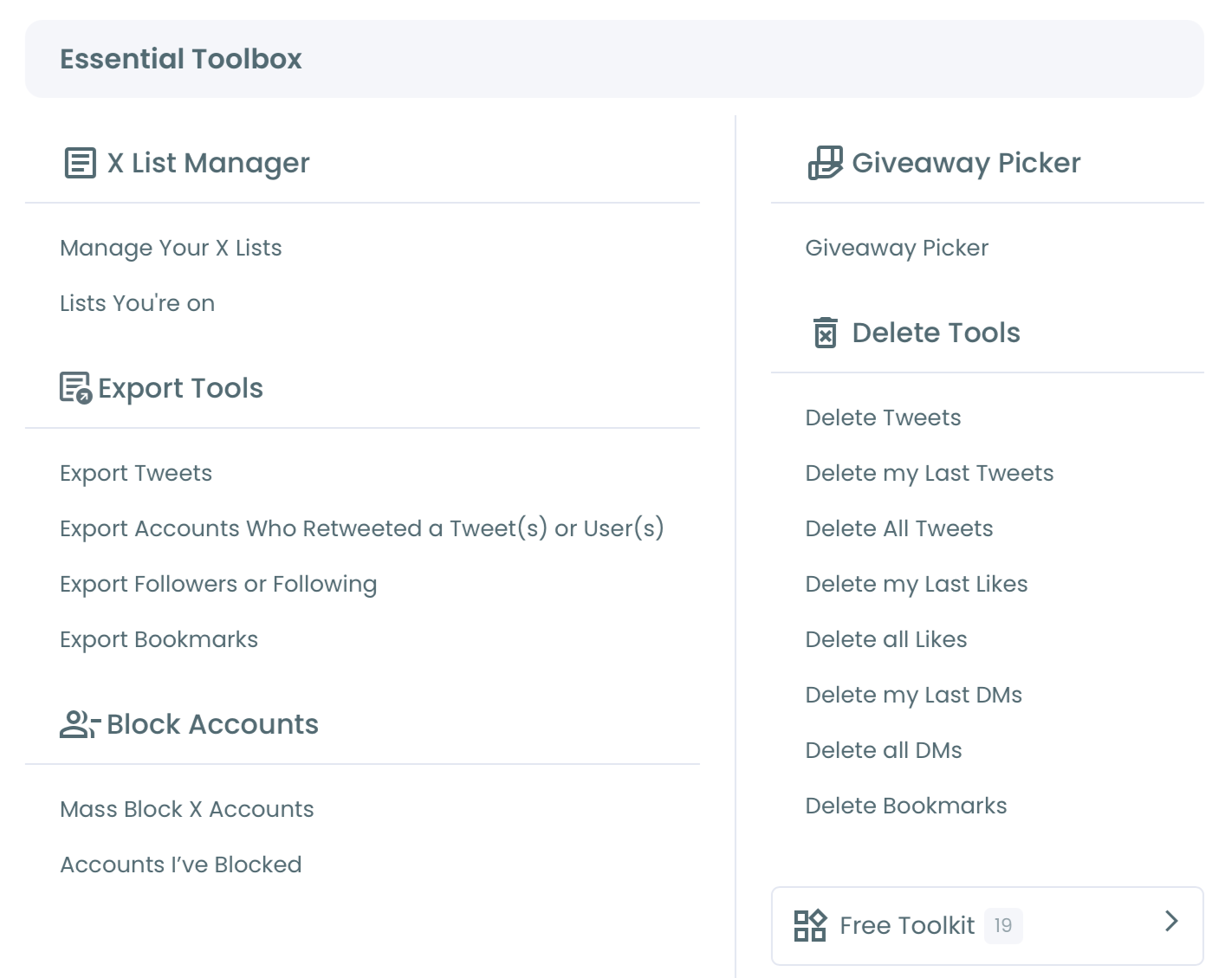
- Open the Essential Toolbox menu and select Delete Tools, then My Tweets.
- Wait for the table to load your recent posts. Circleboom pulls up to your latest 3,200 tweets straight from the live API connection, with impressions, likes, retweets, quotes, bookmarks, replies and creation date shown per row.
- Deselect everything before you filter. Every loaded post arrives pre-selected by default, which is the single most common way people delete more than they meant to.
Narrow to the cringe and delete it
- Open Filter Options and set your keyword. Type the name, handle or hashtag from the first signal. This is the same mechanic behind our delete tweets by keyword tool, applied inside your recent window.
- Set the date range and the post type in the same panel, so the filter covers the window you want cleaned and narrows to replies or quotes when that is where the problem sits.
- Cap the like count rather than setting a floor. The next section explains why the ceiling is the setting that matters here, and it is the one most cleanup guides get the wrong way round.
- Review the filtered rows, then run Delete Selected. Open anything you are unsure about on X first using the row link, because deletion is permanent and Circleboom holds no undo.
Reverse any two of those steps and you will delete something you wanted.
Deselecting before filtering means the tool starts from zero and adds only what you asked for. The keyword narrows scope before any date logic runs. The like ceiling protects the one post from that era that actually worked.
Skip the deselect and every one of the other steps is applied to a set that was already fully selected.
Quick recap: connect, deselect, filter by keyword, bound the dates and post type, cap the likes, review, delete.
Set a maximum like count on Twitter, never a minimum
Every guide on this topic tells you to set a minimum engagement threshold so your best posts survive.
For a general archive purge, that advice is fine. For cringe specifically, it is exactly wrong.
Think about what a minimum does. Set "at least 10 likes" and you keep the popular posts and delete the quiet ones.
But cringe is often popular. The take that aged badly is frequently the take that got traction at the time, which is precisely why people remember it and why it surfaces when someone goes digging.
A maximum does the opposite job, and it is the job you need.
Set "at most 5 likes" inside your target window and Circleboom removes the dead weight while leaving the handful of posts from that period that earned real engagement, which you can then review by hand.
Run the numbers before you set the ceiling
Take a normal account. You posted 40 times a month for six months during a period you would rather forget, so 240 posts sit inside the window.
At a typical distribution, maybe 15 of them cleared 10 likes.
A maximum filter set at 10 hands you 225 automatic deletions and 15 judgment calls.
A minimum filter hands you the exact opposite split, which is the wrong way round for cleanup and a reliable way to lose the one thread you were proud of.
Set the ceiling at roughly double your median engagement and the split lands where you want it.
If your typical post gets 4 likes, a ceiling of 8 removes the noise and surfaces the outliers for review.
The same logic drives our delete low engagement tweets on mobile workflow.
Where the keyword filter quietly misses on X
The keyword field matches the text of the post, not the thread it sits in.
So a reply that says only "same" under a post you now regret carries none of the words you are searching for.
Those survive a keyword-only pass, which is why the date range and the post-type filter run alongside it rather than instead of it.
Circleboom is an official X Enterprise Developer partner, so every deletion goes through sanctioned API access rather than scripted browser automation.
Your account stays inside X's rules while the batch processes, which matters more at 500 posts than at five.
Repeatability follows from that. You can remove cringe tweets in bulk this quarter and again next quarter without accumulating platform risk.
What to do about cringe tweets older than your last 3,200
The 3,200 ceiling is an X API limit, not a Circleboom one, and it defines exactly where this feature stops being the right tool.
If your account posts heavily, 3,200 posts might only cover the last several months. Anything older sits outside what the live connection can reach, and no tool on the market gets past it without your archive file.
The boundary is honest, and it is worth knowing before you assume a single run cleaned everything.
For older material you request your archive from X, which X says may take a few days to prepare. Delete All Tweets then reads that full export rather than the live API window, which is what lets it reach past the ceiling.
Same four signals, same filtering logic, different data source. We wrote up the mechanics in delete more than 3,200 tweets.
If a full history reset is what you actually want rather than targeted cringe removal, delete your Twitter history is the blunter path and it does not pretend otherwise.
Is it safe to delete cringe tweets in bulk?
Yes, provided the deletion runs through official API access and you review the filtered set before confirming.
The risk in bulk operations is almost never the platform. It is scope.
An unreviewed filter that catches 400 posts when you meant 40 is a self-inflicted problem, and it is permanent, because a deleted post cannot be restored by Circleboom or by X.
Two habits remove nearly all of that risk.
Export before you delete, using export tweets to produce a CSV of exactly what is about to go, which becomes your only record afterwards.
And read the row count on the Delete Selected button before you click it, because that number is the honest answer to how big your operation actually is.
Accounts that have been through a genuine reputational cleanup usually run this quarterly rather than once.
Whether a cleanup is worth doing at all is a separate question from how, and our older piece on choosing to delete embarrassing tweets takes that side of it.
Your cleanup checklist
Work through these in order and the whole thing takes about ten minutes:
- Write down the name, keyword or handle you want gone before you open anything.
- Deselect all posts as soon as the table loads.
- Filter by keyword first, then bound the date range and post type.
- Set a maximum like count, never a minimum.
- Export the filtered set, review it, then delete.
Do that once and the worst of it is gone. Do it quarterly and it never accumulates again, which is the actual goal, because the tweet that hurts you in three years is one you are posting comfortably this week.
What to know before you start
Can I get my tweets back after deleting them?
No. Deletion through the X API is permanent, and neither Circleboom nor X keeps a recoverable copy.
Export the filtered set to CSV before you run the batch if you want any record of what was removed.
Will people notice that I deleted a bunch of posts?
Generally not. X sends no notification when a post is removed, and the post disappears from your profile, your followers' timelines and X search.
Anyone who screenshotted it still has the screenshot, which is the one thing deletion cannot solve.
Does deleting tweets hurt my account or reach?
No. Removing posts has no penalty attached to it, and clearing dead low-engagement content can make your visible timeline read stronger to anyone who lands on your profile.
The delete tweets by keywords and hashtags approach is the least disruptive version, since it touches only what you name.
How long does a large batch take?
It depends on volume, since the operation is paced by X API rate limits rather than by Circleboom.
A few hundred posts clear quickly. Several thousand may pause and resume automatically, and the browser needs to stay open until the run finishes.






)
