
The followers who never engage with your posts are the silent portion of your audience that drags down engagement rate without producing any visible signal. Finding them requires a follower-quality audit that surfaces accounts with weak credibility ratios and long-term inactivity, which are the two patterns that almost always overlap with silent-follower behavior on X.
Circleboom's Low Quality Followers feature retrieves your full follower base through official X Enterprise APIs and applies follower-to-following ratio thresholds to surface accounts that contribute weak engagement signals. Each flagged follower includes the credibility data needed to validate the audit before any cleanup action.
→ Run a low-quality follower audit on your X account
Keep reading for the structural reason silent followers drag engagement, the four-step audit workflow, and the cleanup rules that keep audience quality healthy long-term.
Why Silent Followers Hurt Engagement Rate
The engagement rate formula divides total interactions by total followers. Silent followers sit in the denominator without contributing to the numerator, which means every silent account in the follower base directly reduces visible engagement rate even when the active audience is performing well. A 100,000-follower account with 30,000 silent followers will look weaker than a 70,000-follower account with the same active base, even though the actual interaction counts are identical.
The problem compounds over time. Most X accounts accumulate silent followers gradually through viral spikes, follow-back loops, and incidental discovery. None of those mechanisms filter for engagement intent, which means the silent share of an audience generally grows until a deliberate cleanup stops it. Circleboom's breakdown of what counts as a good Twitter engagement rate walks through the numerator-denominator math in more detail.
The third consequence is algorithmic. The X feed-ranking system uses interaction signals from your most recent posts to decide how broadly to surface the next one. When the silent share of your follower base is large, the per-impression interaction signal stays weak, and the algorithm allocates less reach to subsequent posts. Silent followers are not just diluting the visible rate, they are limiting the distribution your active followers would otherwise get.
What Counts as a Follower Who Never Engages
A silent follower is not the same as a fake or bot account. The categories overlap, but most silent followers are real people who followed once, lost interest, and continued occupying a slot in the follower base without unfollowing. The follower-quality audit surfaces this category by combining three measurable signals:
- A weak follower-to-following ratio, typically following thousands while having few followers themselves.
- Long-term low tweet count relative to account age.
- Absence of recent activity even when account age is large.
Any one of those alone is a directional signal. All three together are a high-confidence pattern that the account is structurally unlikely to engage with your content. Circleboom's deep dive on identifying and removing low-quality followers covers each signal with example thresholds.
The reframe worth catching is that silent-follower cleanup is an engagement-rate intervention, not an audience-size strategy. Removing a silent follower does not grow your audience, but it improves the ratio of active to total followers, which is the metric the algorithm and human readers actually respond to. Account credibility tracks engagement ratio, not raw follower count.
How to Find Twitter Followers Who Never Engage Step by Step
Four actions. The setup is one-time and the audit runs end to end in about fifteen minutes for an audience under 50,000 followers.
Connect your X account to Circleboom
- Log in to Circleboom Twitter and authorize the account with the official OAuth flow.

Open the Follower-Following menu
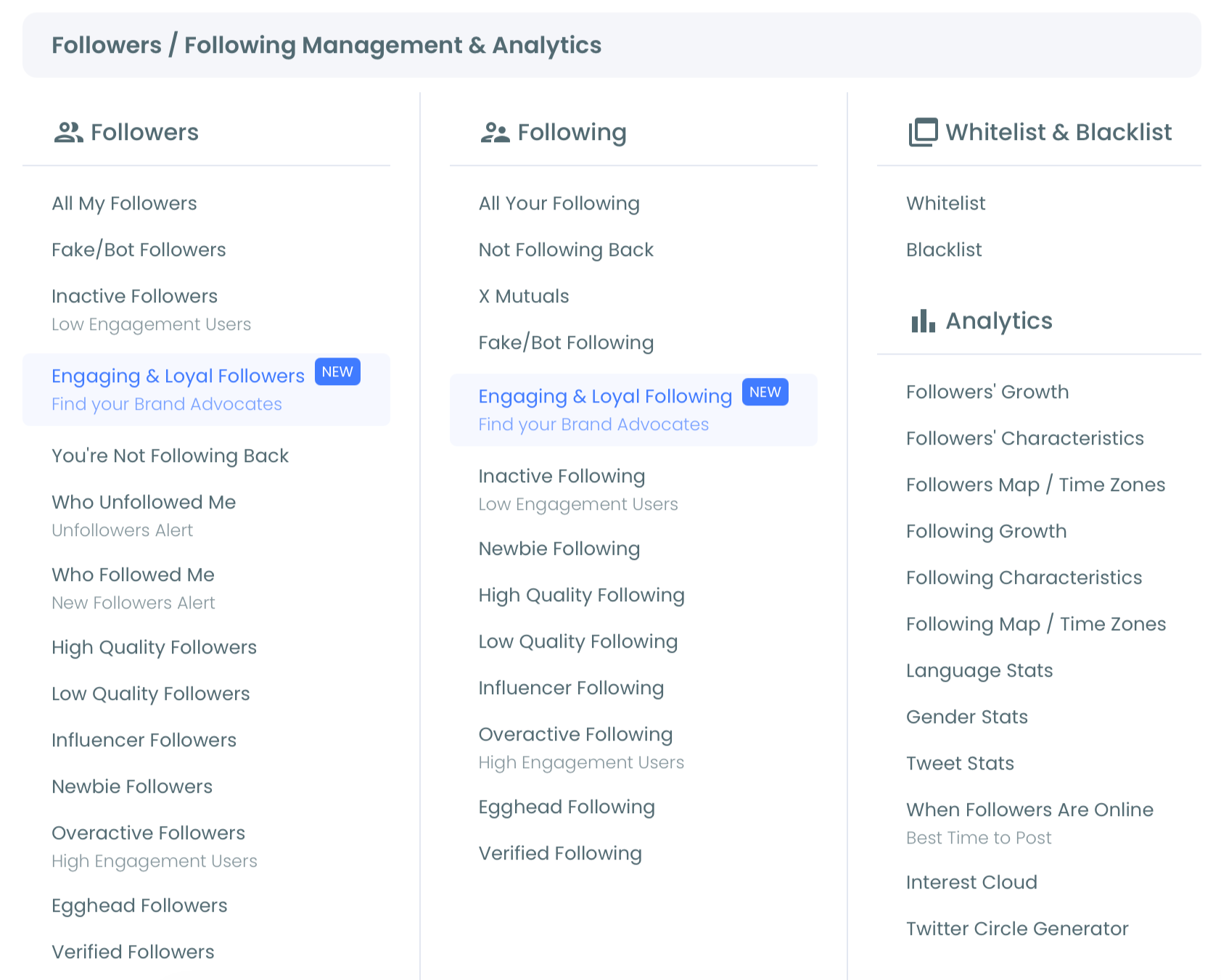
- Open the Follower-Following Management and Analytics menu and click Low Quality Followers to load the audit interface.
Apply ratio and activity filters
- Set the ratio threshold to surface accounts with the weakest follower-to-following signal, then add the tweet-count filter (under 50 lifetime tweets is a useful starting point) and the account-age filter (accounts older than 18 months with low activity are higher-confidence silent followers than newer accounts).
Review the flagged list before removal
- Scan the surfaced accounts by username, bio, and activity indicators to validate that the cleanup target is correct. Use the whitelist function to protect any flagged account that is actually a valuable niche follower with low public activity.
That ordering is what makes the audit reliable. The OAuth login earns sanctioned API access. The menu navigation loads the credibility-scoring surface. The filter combination is what separates noise from signal. The review step is what prevents the cleanup from removing valuable but quiet followers, because accounts that are intentionally low-activity but high-value should stay in the audience.
Video walkthrough: how the credibility-ratio filter surfaces silent followers without flagging valuable low-activity accounts.
What the Audit Actually Returns
The audit returns a structured list of follower accounts with weak credibility signals, each with bio, follower count, following count, ratio, account age, and lifetime tweet count visible in the same row. That structured view is what makes the validation step practical, because the alternative of clicking through profiles one at a time does not scale beyond a few dozen accounts.
The data is sourced through Circleboom's status as an official X Enterprise Developer company, which means every account in the list comes from sanctioned API access rather than scraping. The audit also runs against X's published platform limits so any subsequent removal action stays within policy.
The compliance layer matters more once the audit identifies hundreds or thousands of silent followers and the cleanup begins. Sanctioned API access is what keeps a bulk cleanup from triggering platform-level restrictions on the account performing the cleanup.
Two adjacent audits often pair well with the silent-follower cleanup. The engaging followers and following view shows the opposite end of the audience, the loyal active segment whose engagement is carrying the account.
The follower quality and following quality scoring gives a complementary credibility score that helps prioritize cleanup targets. Together those three surfaces produce a complete audience-quality picture rather than just a deletion target list.
Pew Research's data on American Twitter use shows that the active share of X users is a minority of total users, which is structurally consistent with the silent-follower pattern most accounts observe in their own follower base. Statista's Twitter topic overview covers the platform-level engagement trends that frame the rate-restoration math.
Run a low-quality follower audit on your X account is the workflow that turns the silent share of your audience from invisible cost into a visible cleanup target.
Related Circleboom reading that extends the silent-follower angle:
- Twitter scarecrows are the silent engagement killers you need to remove on the engagement-killer framing.
- Remove Twitter followers who don't engage on the removal-action side.
- Is it better to have lots of Twitter followers or fewer more engaged ones on the size-versus-quality trade-off.
FAQ
Will removing silent followers actually raise engagement rate?
Yes, mechanically. The engagement rate formula divides interactions by follower count, so removing silent accounts shrinks the denominator without changing the numerator. The visible rate improves immediately. The algorithmic benefit (better signal density per post) takes a few weeks to surface in feed distribution.
How many silent followers should I expect to find in a typical audit?
Most audited accounts find that 20 to 40 percent of their follower base meets at least one silent-follower signal, with the share varying by how the account grew. Accounts that grew through viral content tend to have higher silent ratios than accounts that grew through niche-community engagement.
Is it safe to remove silent followers?
Yes. The removal runs against the official X API and stays within platform rate limits. The safety question is more about audience curation than platform compliance, which is why the audit includes a review step before any action.
Can I export the silent-follower list before removing?
Yes. The flagged list exports to CSV for record-keeping or external analysis, which is useful when the cleanup decision requires team review or when the audit is part of a recurring audience-health report.
How often should I run the silent-follower audit?
Quarterly is enough for most accounts. Faster-growing accounts (viral spikes, follow-back campaigns, paid acquisition) benefit from monthly audits because silent followers accumulate faster.
How to Decide Whether to Run the Audit Now
The audit is worth running when visible engagement rate has been declining for three or more months even though active followers seem stable. It is also worth running when the follower base has crossed a growth milestone (10K, 50K, 100K) that triggers a more visible rate calculation, or before any monetization push, because brand deals and creator-fund eligibility check engagement rate as a primary signal. A denominator full of silent followers is a directly fixable obstacle to that revenue.
The audit is less urgent when the follower base is small (under 5,000) and the active share already feels visible in normal post performance, because the rate-restoration math has less to recover in that range. In every other scenario, the silent share of the audience is paying a cost that the audit can quantify and the low-quality follower cleanup can remove.