
The shared follower question matters because the people who follow both you and a competitor are the most valuable audience segment in any competitive space. They have already self-selected as interested in your topic, they are already comparing options, and they are the audience most likely to deepen engagement with whichever account gives them more value over time.
Circleboom's Account Comparison and Benchmark Report retrieves two X account profiles through official X Enterprise APIs, calculates the overlap between their follower bases, and surfaces the shared followers as a structured list with full profile context. The same report includes ratio reads, post-velocity comparison, and follow-activity benchmarks.
→ Find shared followers with a competitor on Twitter
Keep reading for the workflow, the strategic reads the overlap actually produces, and how to act on the list once you have it.
Why Shared Followers Are the Most Valuable Segment
The overlap audience is pre-qualified in two dimensions at once. They have already confirmed interest in your topic by following an established competitor, which removes the "is this person interested" filter that most audience-targeting work has to start with. And they have already confirmed willingness to follow more than one account in the space, which means they are open to multiple sources of value on the same topic.
That dual qualification makes the overlap audience disproportionately responsive. Outreach to a random follower of a competitor often fails because the random follower may not have any reason to consider you. Outreach to someone who follows both already signals their willingness to engage with multiple options, which makes the conversation start from a warmer baseline.
The strategic value compounds in collaboration and partnership conversations. The size of the overlap is a defensible metric when discussing potential cross-promotion: "We share roughly 12 percent of our follower bases, and that audience already engages with both of us" is a much more concrete frame than generic audience-size comparisons. The shared-follower number is the metric that justifies the cross-promotion in real terms.
The cost of not measuring the overlap is operating on assumed competitive overlap rather than measured. Most operators believe they share a larger or smaller overlap with specific competitors than they actually do, and acting on the assumption produces miscalibrated strategy. The account comparison and benchmark report is what replaces the assumption with the number.
How to Find Shared Followers With a Competitor Step by Step
Four actions, all one-time setup. The report runs in minutes and can be re-run against different competitors as the comparative landscape shifts.
Connect your X account to Circleboom
- Log in to Circleboom Twitter and authorize your X account with official OAuth.
Open the Monitoring menu
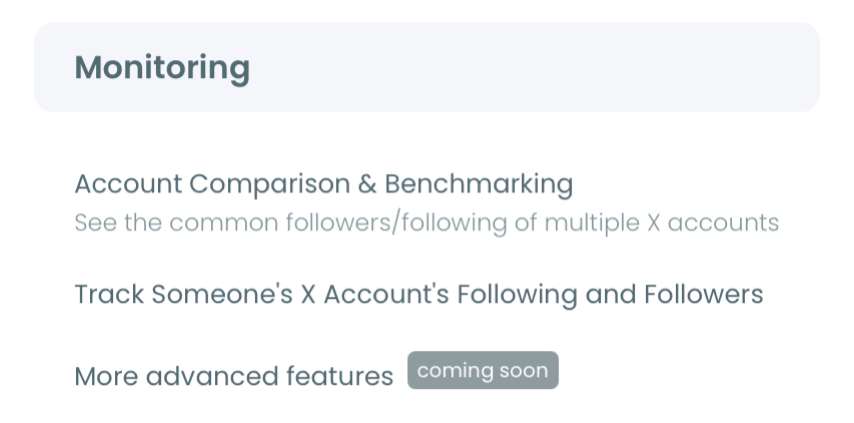
- Open the Monitoring menu and click into the Account Comparison and Benchmark Report to load the comparison interface.
Enter the competitor account handle
- Type the competitor's X handle into the comparison field. The report retrieves both follower lists, calculates the overlap, and renders the shared-follower segment as a structured list.
Read the overlap, scan the profiles, decide the action
- Review the shared-follower list with the strategic question in mind: are these accounts you should be engaging with directly, adding to a monitoring list, or targeting in a content campaign aimed at deepening their engagement with you specifically.
That sequence is what turns the abstract competitive-overlap question into a structured dataset. The login earns sanctioned API access. The Monitoring menu loads the right report. The handle input runs the comparison. The review step is where the data becomes action.
Video walkthrough: how the Account Comparison report surfaces the exact list of followers shared between two X accounts.
What the Overlap Actually Tells You
The first useful read is the absolute overlap count. If you and a major competitor share 800 followers, that is a meaningfully different strategic situation than sharing 80. The absolute number tells you how much overlap exists, which informs the size of the audience you can target with overlap-aware content or outreach.
The second useful read is the overlap percentage relative to your own audience. Sharing 800 followers when your total is 5,000 (16 percent) is a different signal than sharing 800 when your total is 50,000 (1.6 percent). The percentage tells you how much of your audience is comparative-shopping, which informs whether positioning differentiation needs to be a stronger part of your content.
The third useful read is the directional comparison. Comparing your overlap with three different competitors produces a ranking of which competitive accounts share the most audience with you, which is a more useful read than any single comparison alone. That ranking tells you which competitors are actually competing for the same readers and which are operating in adjacent rather than overlapping spaces.
Circleboom is an official X Enterprise Developer company, so the retrieval runs against X's published platform limits for compliant access. The same Monitoring menu surfaces a track-someone-X-followers-and-followings view for ongoing competitor monitoring beyond the one-time overlap snapshot.
Pew Research's analysis of America's news influencers puts the cross-platform audience-overlap question in context, particularly the concentration on X. The Stanford academic foundation on influence quantification provides the methodological framework for measuring follower-network overlap in a rigorous way.
Find shared followers with a competitor on Twitter is the page that runs the comparison.
Related Circleboom reading that goes deeper on the comparative angles:
- how to find common followers between Twitter accounts without coding on the no-code workflow.
- compare Twitter followers between two accounts on the comparison mechanics.
- Twitter competitor analysis on the broader competitive read.
- how to analyze your competitor's Twitter account on the deeper competitor audit.
FAQ
Does Circleboom need access to the competitor's account?
No. The comparison runs against public follower data, so you only need to enter the competitor's handle. The retrieval works on any public X account.
Can I compare against multiple competitors at once?
Each comparison runs as a pairwise report. To compare against three competitors, you run the report three times. The pairwise approach gives you cleaner reads per competitor than a multi-account view would.
Is the overlap count exact?
The overlap reflects the follower lists at the time of retrieval. Both your own and the competitor's lists change over time, so the overlap is a snapshot rather than a permanent number. Re-running the report periodically tracks how the overlap evolves.
Can I see the actual list of shared follower accounts?
Yes. The report surfaces the shared-follower list with full profile context (username, bio, follower count, account age, verification, engagement signals), not just an aggregate count.
Does the report cover follower-and-following overlap or just followers?
The Account Comparison and Benchmark Report focuses on follower overlap as the primary metric, because that is the audience-targeting question most operators care about. The related Monitoring tools cover the following-side activity tracking separately.
How the Two Approaches Compare
The structured comparison report gives you the overlap count, the shared-follower list, and the ratio reads in a few minutes. The alternative is scrolling through both follower lists by hand and trying to spot the overlap, which is not viable for any audience size past a few hundred followers.
The decisional cost of staying with the manual approach is operating without the overlap data. The decisional cost of using the structured report is the few minutes the report takes to run. The trade-off is straightforward, and the strategic reads the report enables (positioning differentiation, partnership prioritization, cross-promotion sizing) are difficult to replace with any other input.
Run the shared-follower comparison and the next time someone asks how much overlap you have with a specific competitor, you will have the count, the list, and the strategic context to answer with specifics instead of an estimate.