

Operators trying to generate leads on Twitter usually have one of two problems: their discovery surface is too shallow (X native search returns 200 to 500 surface-level matches), or their engagement is too generic (mass-DM and reflexive replies do not convert).
The replacement is a three-phase workflow that targets accurately, engages contextually, and routes leads cleanly into a CRM.
What this guide gives you.A precise ICP-targeted discovery process surfacing 1,000+ relevant accounts.A high-context engagement framework that respects platform norms.A clean CRM handoff that does not lose leads at the social-to-sales boundary.
Built on Circleboom's verified Enterprise developer access on X. Start with Find Twitter Influencers.
Why the Default Twitter Lead-Gen Approach Fails
Most teams default to a workflow that produces near-zero pipeline: search X native for industry keywords, reply broadly to whoever shows up, send cold DMs to anyone who follows back, hand inbound interest to a social-media coordinator. Each step in the workflow has a structural problem.
Native search is biased toward loud accounts that are usually other marketers, not the actual ICP. Generic replies train the algorithm to discount the engager. Cold DM violates platform spam-detection thresholds.
Coordinator-as-gatekeeper loses 40% of qualified leads at the handoff. The article on maximizing ROI with B2B lead generation campaigns covers the same failure pattern from a campaign design perspective.
The replacement workflow fixes all four steps simultaneously, on the same Circleboom dashboard.
How to Generate Leads on Twitter (Step by Step)
The flow has three phases: discovery, engagement, lead routing. Each phase has its own success criteria and its own tools.
Hands-on demo: how Find Influencers ranks accounts by reach, engagement, and authority.
The process, step by step.
Phase 1: Discovery
- Log in to Circleboom Twitter and connect your X account through OAuth.

- Open the Advanced X Search menu for the discovery workspace.
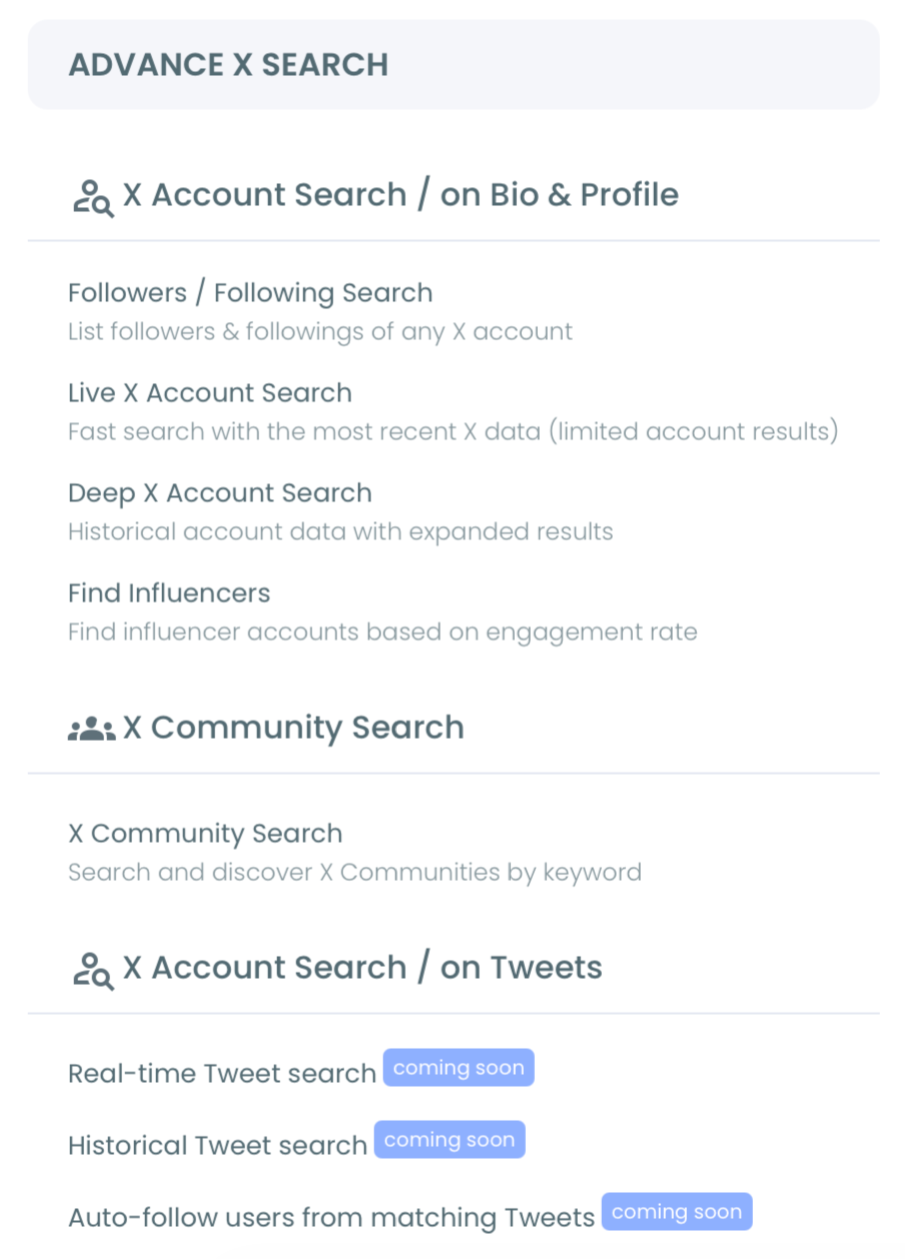
- Run Find Influencers with your ICP keyword set (target persona, vertical, technology stack, region) to surface accounts ranked by reach, engagement, and authority.
Phase 2: Engagement
- Categorize surfaced accounts into priority tiers: top-priority (5–10 accounts for weekly engagement), mid-priority (20–50 for monthly), watchlist (100+ for quarterly review).
Phase 3: Lead routing
- Route inbound DMs and engagement signals directly to the sales team, bypassing the social-media coordinator. Include full Twitter-context attached to each handoff.
That sequence is what makes lead-gen on Twitter compounding rather than transactional. Discovery surfaces the right targets; engagement earns the relationships; the CRM handoff captures the leads.
Quick recap:
- Connect through OAuth.
- Open Advanced X Search.
- Run Find Influencers on the ICP keyword set.
- Tier the surfaced accounts.
- Route inbound traffic directly to sales.
What ICP Targeting Actually Looks Like
The ICP keyword set drives the discovery quality. For B2B SaaS, four keyword categories matter:
- Target persona role keywords ("VP of Engineering," "Head of Product," "DevOps Lead").
- Vertical keywords (the industries your product serves, like "fintech" or "healthcare AI").
- Technology stack keywords (the tools your product integrates with, like "Kubernetes" or "GraphQL").
- Geographic keywords (the regions where your sales team operates, when relevant).
The combined keyword set surfaces accounts that match the ICP precisely rather than the broad "marketing" cohort that always shows up first. The article on generating business leads from LinkedIn covers the same ICP-targeting principle applied to a different platform.
How the Engagement Framework Works
Three engagement shapes consistently outperform the default reply pattern.
The high-context reply demonstrates that the engager has read the original post, has an informed perspective on it, and is engaging in good faith. The article on engaging with followers on Twitter covers the engagement-side mechanics in detail.
The useful quote-tweet adds information, context, or counterpoint to the original post and earns algorithmic distribution from both audiences.
The curated DM is sent to accounts that have already engaged with the engager's content (replied, quote-tweeted, mentioned). The prior engagement is what differentiates the DM from cold-DM spam.
Browser-script automation tools that promise to scale these shapes violate X's automation policy. The article on keyword-safe alternative to Twitter auto-follow covers the safety question. The legitimate version uses Circleboom for discovery and human work for the engagement.
What to Avoid in Twitter Lead-Gen
Three failure modes account for most workflows that produce no pipeline.
- Mass-DM. Sending the same DM to hundreds of accounts triggers X's spam-detection.
- Generic-reply spam. Reflexive affirmations train the algorithm that the account engages without judgment.
- Browser-script automation. Tools that simulate clicks risk account suspension.
The legitimate workflow avoids all three through manual high-context engagement supported by Circleboom's discovery and analytics layer.
What Comes After the Workflow Holds
Once the workflow runs cleanly for a quarter, three downstream optimizations compound the value.
- Refresh the ICP keyword set quarterly as positioning evolves.
- Add a Twitter follower tracker to monitor engagement-positive prospects automatically.
- Run quarterly audits on the engaged-account list to identify which prospects converted and which patterns predict conversion.
The article on identifying your most valuable followers and brand advocates covers the audit-side workflow at the audience-curation level.
What to Do Next
The workflow is concrete: discover, engage, route.
- Step 1: Open Circleboom and run Find Influencers on your ICP keyword set.
- Step 2: Tier the surfaced accounts and start engagement on the top tier.
- Step 3: Fix the CRM handoff so qualified leads reach sales directly.
- Step 4: Set the workflow on a quarterly review cadence.
What to Know Before You Start
How long until the first qualified leads arrive?
For most B2B teams, 2 to 4 weeks of consistent engagement on the top-priority tier produces the first qualified leads. The compounding effect (inbound traffic from the engagement network) kicks in around month 2 to 3.
How many accounts can a single engagement-amplifier handle?
Roughly 25 to 50 accounts per amplifier per week, sustained. Larger teams scale by adding amplifiers, not by automating the engagement.
Is the workflow ICP-agnostic or does it favor certain B2B verticals?
The workflow is ICP-agnostic. The ICP keyword set is what tunes it to specific verticals. Teams in software, fintech, healthcare, and professional services have all run the same workflow shape successfully.
Is the discovery layer safe under X's terms of service?
Yes. Circleboom's Enterprise developer access on X is the official integration tier; all discovery and analytics run through documented endpoints with rate-limit pacing.




)


