
Topic-based feeds are the answer to a specific reading problem: your following list is wide enough that posts about the topics you care about get mixed in with posts about everything else. Grouping accounts into focused topic clusters gives you a separate feed per topic, which is the structural fix to a feed that has become topically blurred.
Circleboom's X List Manager retrieves your follower base through official X Enterprise APIs and supports bulk-adding accounts into named topic Lists. Each List becomes a focused feed on its own topic, accessible from the X home feed alongside the main timeline.
→ Organize Twitter by topic with X Lists
Keep reading for the structural reason topic-based organization works, the workflow to build the clusters, and how to maintain them across the year.
Why Topic-Based Organization Beats One-Feed-Fits-All
The main timeline is structurally topic-blind. Every account you follow contributes to one feed, and the algorithm decides which posts surface. That works when your interests are narrow. It breaks when your interests span three or four topics, because each topic gets crowded by the others, and the strongest reads on any specific topic get lost in the broader noise.
Topic-based Lists invert the structure. Each List is a focused feed on one topic, populated only by the accounts you put on it. You can read about industry trends on one List, learn about an adjacent technical field on another, and watch competitor activity on a third. The total volume of content you have access to grows, and the topic-level depth on each surface improves.
The strategic value compounds for anyone who reads on X for work. Without topic Lists, the cost of following an expert in a niche topic is the cost of having their off-topic posts in your main feed. With topic Lists, that cost goes away, because the expert's on-topic content lives on the right List and their off-topic content does not interfere with anything you are trying to read elsewhere.
The cost of skipping topic-based organization is the cost of either following narrowly (and missing depth) or following broadly (and losing topic clarity in the main feed). Most operators end up making that trade implicitly, by unfollowing accounts whose topics they care about because the off-topic posts feel costly. Topic Lists remove the need for that trade.
How to Organize Twitter by Topic Step by Step
Four actions per topic cluster. The build is one-time and the maintenance is quarterly.
Connect your X account to Circleboom
- Log in to Circleboom Twitter and authorize your X account with official OAuth.

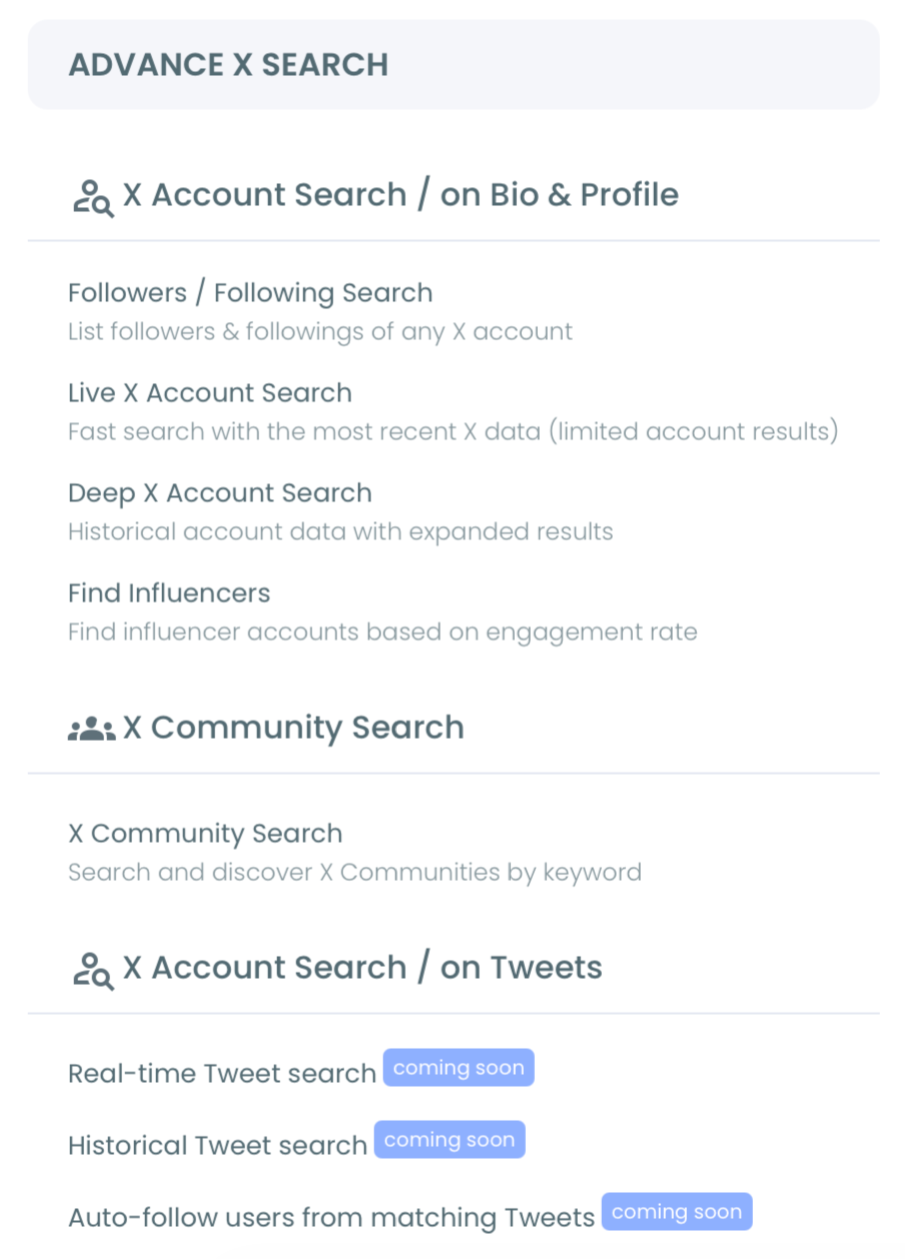
Open the X List Manager from Advanced X Search
- Open the Advanced X Search menu and click X List Manager to load the bulk list-building interface.
Create a topic List with a clear name
- Create a new list with a descriptive topic-based name (something like "AI research," "startup hiring," "creative writing") and set the visibility to private for monitoring or public for sharing the curated topic feed.
Bulk-add accounts that fit the topic
- Add accounts to the topic List in bulk from your followers, from search results, or by entering usernames directly. Aim for at least 30 accounts so the topic feed has enough volume to feel populated. Repeat for each additional topic you want to organize.
That sequence is the working setup. The login earns sanctioned API access. The dashboard loads the bulk-build surface. The descriptive topic-name keeps the cluster legible. The bulk-add is what makes the topic List scalable. Skipping the bulk-add and falling back to manual entry is what makes most topic-organization attempts collapse before producing value.
Video walkthrough: how the bulk-add workflow turns topic-based organization from a slow chore into a fifteen-minute build.
What Topic Organization Pays Back
The first payback is topic depth. Reading a focused List on one topic gives you the kind of immersive context that scrolling the main feed cannot, because you are seeing every relevant post in sequence rather than scattered among unrelated content.
The second payback is broader following without main-feed cost. With topic Lists, you can follow many more topic-specific accounts than the main feed could absorb, because their content lives on the topic List rather than crowding the main surface. The total following expands while feed quality stays high.
The third payback is dedicated reading modes per topic. Morning reads of the industry-news List for what is happening. Lunch-break reads of the research List for ambient learning. End-of-day reads of the competitor List for monitoring. Each surface fits a different reading purpose, and the total time spent on X feels more productive.
There is one reframe worth catching. Most people organize their following list mentally (this account is for topic X, that account is for topic Y) and rely on memory plus the main feed to surface the right content at the right moment. The actual mental model that fits the platform is to push the organization into the structure itself: build the topic clusters as Lists and let the structure carry the organization instead of memory.
Circleboom is an official X Enterprise Developer company, and all list operations run against X's published platform limits. X Help's documentation on Lists covers the native behavior and platform-level constraints.
X Communities is the adjacent native feature for joining curated topic feeds maintained by others, complementing personal topic Lists. Social Media Today's reporting on X's topic-tag expansion covers the platform's ongoing investment in topic-organized feeds.
Organize your Twitter by topic is the workflow that handles the bulk-build and maintenance.
Related Circleboom reading that goes deeper on the topic-organization angle:
- how to grow a crypto community on the community-building side of topic organization.
- scrape Twitter following list on the list-extraction angle.
- does a protected Twitter X account hide your following list on the privacy-axis layer.
- best Twitter following export Chrome extensions on the export-tooling alternatives.
FAQ
How many topic Lists should I build?
Start with two or three for the most distinct topics you read about. More can come later as you learn which topic surfaces you actually use. Most operators end up with five to eight active topic Lists.
Can I move accounts between topic Lists?
Yes. The bulk-move feature in the list manager lets you reorganize accounts as their content focus shifts. That maintenance is part of why the structured workflow holds up over time.
Should I make my topic Lists public?
Default to private unless there is a specific reason to share. Private Lists protect competitive or research targets, while public Lists work for curation and authority-building when you want others to follow your topic feeds.
Will topic Lists affect what my main feed shows?
The main feed continues to draw from your full following list. The topic Lists are additional surfaces, not replacements. Some operators find their main feed quality improves indirectly because the algorithm gets clearer engagement signals when the niche reading happens on dedicated topic Lists.
How often do topic Lists need maintenance?
Quarterly is sufficient for most. The maintenance is short: scan for accounts that have gone dormant or shifted topics, remove the misfits, add new accounts you have discovered in the topic.
Your Action Checklist
The short version. Run through it once per topic cluster.
- Connect your X account to Circleboom. One time.
- Open the X List Manager from the Advanced X Search menu. Per session.
- Create a topic List with a clear descriptive name. Per topic.
- Bulk-add at least 30 accounts that fit the topic. Per topic.
- Pin the topic List to your home feed on the X mobile app. Per topic.
- Run a quarterly maintenance cleanup. Recurring per List.
Organize your Twitter by topic and the topical depth you have been missing in the main feed will start being accessible on dedicated topic surfaces.