A Twitter bot audit is the structured process of identifying spam, fake, and bot accounts in your follower or following list, reviewing the suspicious entries against their profile signals, and removing the ones that survive the review. The platform does not provide this workflow natively, which is why audits have to happen externally.
Circleboom retrieves your follower and following lists through official X Enterprise APIs, applies a multi-signal classifier (account age, tweet count, follower-to-following ratio, activity pattern), and presents a structured list of suspicious accounts with full profile context for review and bulk action.
→ Run a Twitter bot audit
Keep reading for the audit workflow on both followers and following, the signals the classifier uses, and how to act on the result without removing real accounts by mistake.
What a Twitter Bot Audit Actually Covers
A complete bot audit has three layers. The first is your follower list: spam and bot accounts that have started following you, usually arriving in waves after viral posts or topic-trending content. The second is your following list: accounts you may have followed during a follow-back wave that turned out to be bots. The third is the engagement layer: accounts that interact with your content (likes, replies, reposts) but never become long-term followers, often because they are automated.
The audit matters because all three layers distort your analytics. Bot followers depress your engagement rate by inflating the denominator. Bot following dilutes the quality of your timeline and the signal you give the platform's recommendation system. Bot engagement makes individual posts look stronger than they actually are with real audiences.
The strategic cost compounds. X's transparency reporting shows the platform itself removes millions of inauthentic accounts per period, but those sweeps happen on the platform's schedule, not yours, and the gap between sweeps is exactly where account-level audits are valuable. The Twitter bot checker workflow is the user-side audit layer that runs on demand.
How to Run a Twitter Bot Audit on Your Account
The structured workflow has four steps. The login is the only one-time setup, and the rest can be repeated on whatever cadence matches your audience growth pattern.
Connect your X account to Circleboom
- Log in to Circleboom Twitter and authorize your X account with official OAuth. The retrieval pipeline starts immediately.

Open the Follower / Following Management menu
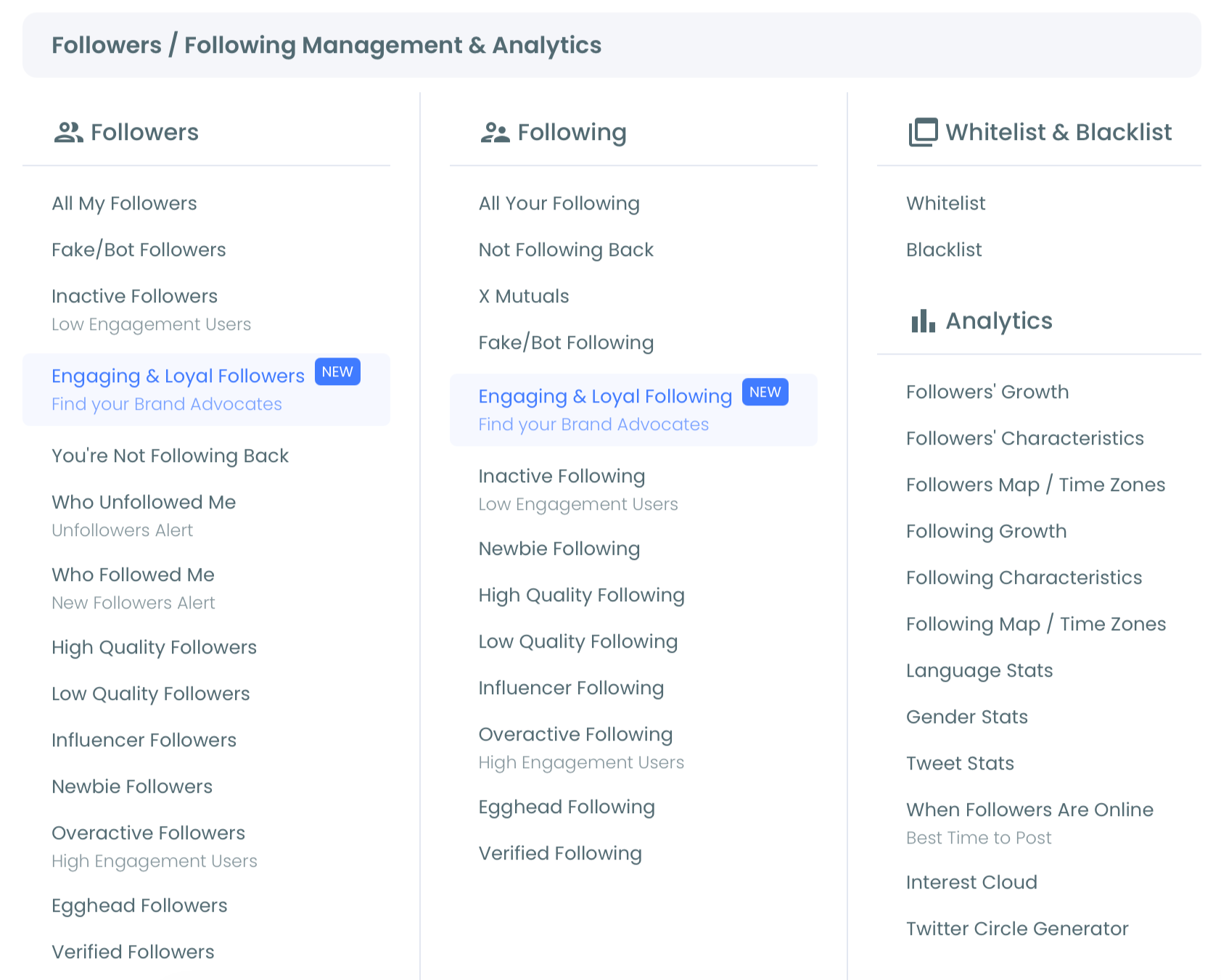
- Open the Follower / Following Management and Analytics menu and click into the bot-checker section. The dashboard loads your followers and following with classification flags applied.
Review the flagged accounts
- Open the suspicious-account list and scan the profile data for each entry: account age, tweet count, follower-to-following ratio, activity indicators, and bio content. The classifier is data-driven but not infallible, so the review step is what separates real cleanup from accidental removal of borderline-real accounts.
Take action on confirmed bots
- Use the bulk action to remove confirmed bot followers, add them to a blacklist for future filtering, or run unfollow on bot accounts in your following list. Each action runs within X's published rate limits, so the cleanup stays compliant.
That sequence is the whole audit. The login earns sanctioned API access. The dashboard surfaces the classification. The review step prevents false positives. The action step is where the audit becomes cleanup. Skipping the review step is the single most common audit mistake, and it produces removal of real accounts you would have wanted to keep.
Video walkthrough: how the bot-classifier dashboard surfaces suspicious accounts with full profile context for review and bulk action.
Why the Multi-Signal Audit Beats Single-Signal Checks
Most quick bot checks rely on one signal at a time: account age, tweet count, or follower ratio. Each signal alone produces a lot of false positives. A new account is not necessarily a bot. A low-tweet-count account might be a quiet reader. A high follow-to-follower ratio might be a curated reader account.
The combined-signal approach is what makes the audit trustworthy. An account that is new AND low-tweet-count AND has an unusual ratio AND has zero original content is much more likely to actually be a bot than an account flagged by any single signal. Circleboom's bot checker layers these signals so the suspicious-list reflects pattern overlap, not single-axis flags.
There is one reframe worth catching. Most people think of a bot audit as "find and remove the obvious bots." The more useful frame is "find the accounts whose pattern overlap is high enough to warrant review, and use the review step as a deliberate decision rather than a reflex." That framing produces cleaner audits and fewer accidental removals of borderline-real accounts.
The fake Twitter account checker handles the individual-account verification side when you need to drill into a specific suspicious account before applying bulk action. The remove Twitter X followers view handles the action layer at scale.
Circleboom is an official X Enterprise Developer company, so the retrieval and action layers run against X's published platform limits with no scraping involved. X's official platform manipulation policydefines the categories of inauthentic behavior that user-side audits target. TechCrunch's reporting on the persistence of the verified bot problem confirms that even paid-verified accounts can be bot-driven, which is why the audit cannot rely on verification alone.
Run the Twitter bot audit on your account is the workflow that turns the abstract bot question into a structured cleanup.
Related Circleboom reading that goes deeper on adjacent angles:
- how many of my X followers are bots on the count-first question.
- Twitter bot checker on the tool overview.
- how to stop bots from following you on X Twitter on prevention.
- difference between bots and automated accounts on X on the category distinction.
FAQ
How often should I run a Twitter bot audit?
The right cadence depends on growth pattern. Accounts with steady growth can audit quarterly. Accounts that experience viral spikes should audit within a few days of the spike, because bot follow-waves usually arrive within 24 to 72 hours after surge-driving content.
Does the audit also check accounts I am following?
Yes. The dashboard surfaces both follower-side and following-side bot signals, because following bot accounts dilutes the quality of your timeline and your recommendation signal to the platform.
Will removing bot followers hurt my account?
No. Removing inauthentic followers usually improves engagement rate because the denominator shrinks while the numerator (real interactions) stays the same. Account credibility also improves because the visible audience reflects real attention.
What signals does the classifier use?
Account age, tweet count, follower-to-following ratio, activity pattern, and profile completeness are the primary signals. The combination of multiple signals overlapping is what produces the suspicious flag, not any single metric.
Can the audit produce false positives?
Yes. Any classifier produces false positives at the borderline. That is why the review step is mandatory before bulk action. The dashboard exposes full profile data for each flagged account so the review is a quick visual scan, not a deep dive per account.
Reinforcing Why the Audit Workflow Holds Up
The reason the workflow holds up is the structural pairing of automated classification with human review. Pure automation produces too many false positives. Pure manual inspection does not scale past a few hundred accounts. The combination is the only approach that handles audience-size growth without producing either accidental cleanup or chronic uncleaned bot accumulation.
The cadence question matters more than most operators expect. A single audit done well is useful. A quarterly audit done consistently produces noticeably cleaner analytics over time, because each pass surfaces the new bots that arrived since the last review. Stopping after one audit defeats the purpose, because the bot population on X is not static.
Set up the Twitter bot audit workflow and the next time someone questions whether your follower count is real, you will have the audit history and the cleaned-base data to answer with specifics.