
The follower count on your profile is one number, and "famous" is a property of accounts that number does not surface. Most people use "famous follower" to mean an account with a large audience, a verified badge, or strong engagement, and the native X interface offers no way to filter the follower list by any of those properties.
Circleboom's Influencer Followers feature retrieves your audience through official X Enterprise APIs and surfaces the accounts in it that combine high engagement rate with meaningful follower counts. The result is a structured list of the followers most likely to amplify your content, sorted by influence signal instead of follow date.
→ Find your most famous Twitter followers
Keep reading for the definition Circleboom uses, the workflow to surface the list, and what to actually do with the names once you have them.
What "Famous" Means in a Follower Context
Famous, in audience-management terms, usually means one of three overlapping things. It can mean follower count: accounts with audiences in the tens or hundreds of thousands. It can mean verification: blue or gold badges that signal credibility. Or it can mean engagement influence: accounts whose posts consistently generate interaction relative to their audience size, regardless of follower number.
The most useful definition for actual content strategy is engagement influence, not raw follower count. A 30,000-follower account with 4 percent engagement is meaningfully more amplifying than a 300,000-follower account with 0.1 percent engagement. The first one moves content. The second one mostly does not. The native follower list has no engagement metric, so neither definition is visible there.
Circleboom's Influencer Followers feature uses the engagement-weighted definition. Accounts qualify when they combine reasonable follower bases with engagement rates that suggest their content actually moves through their network. That is the definition that matters when you are thinking about which followers are worth your attention, your follow-back, or your collaboration time.
The cost of relying on follower-count-only definitions is real. Most operators who scan their follower list for "famous" accounts end up with a list of large-audience accounts that do not actually engage with their content, and miss the smaller-but-active influencers who would have amplified posts directly. The hidden-influencer-among-X-followers angle is real and undercovered by default.
How to Find Your Most Famous Twitter Followers Step by Step
Four actions, three setup and one weekly review. The list populates the moment the snapshot loop starts.
Connect your X account to Circleboom
- Log in to Circleboom Twitter and authorize your X account with official OAuth.

Open the Influencer Followers section
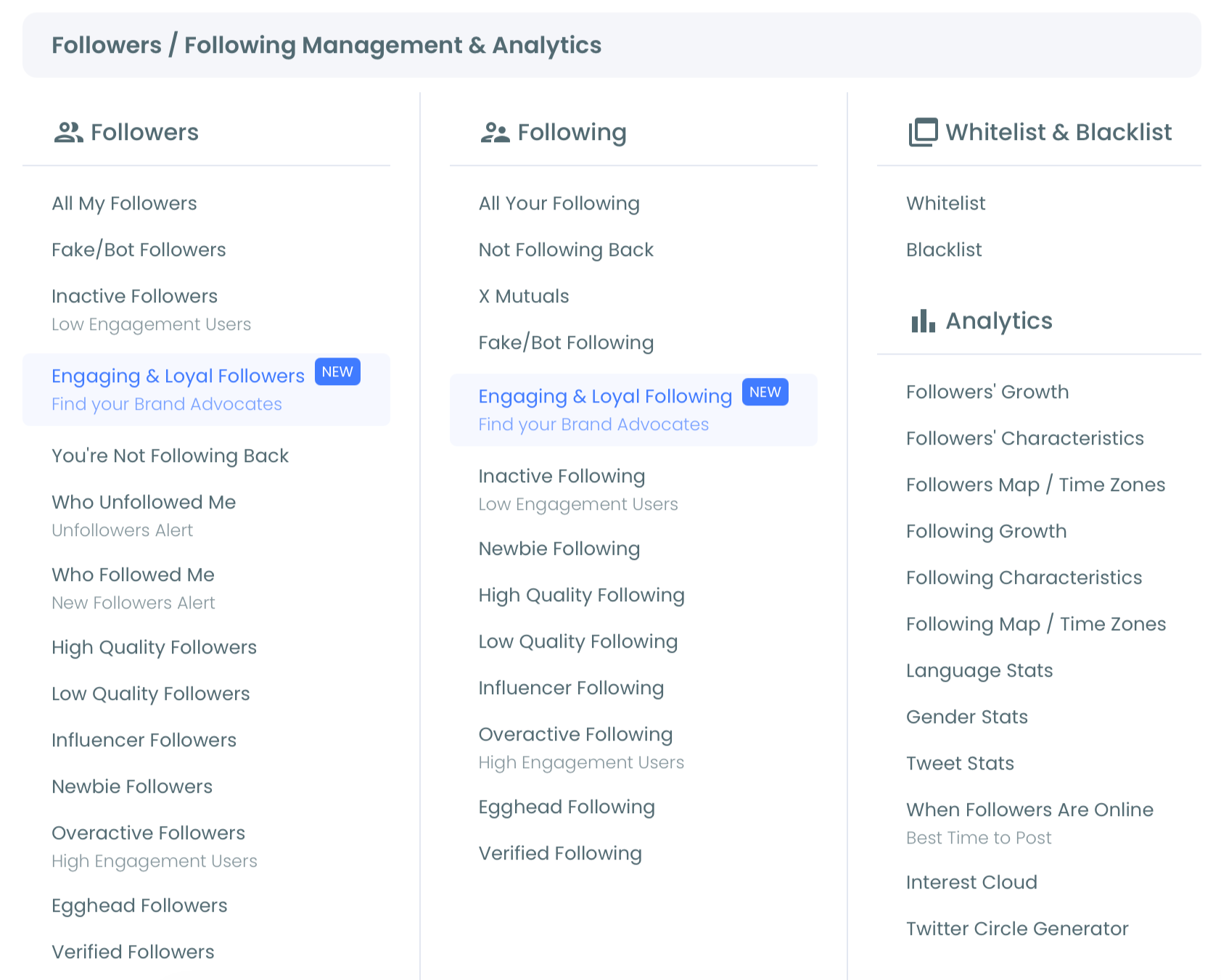
- Open the Follower / Following Management and Analytics menu and click Influencer Followers to load the list of high-engagement accounts already in your audience.
Apply secondary filters for niche relevance
- Filter the list by language, location, bio keyword, follower count range, account age, or verification status. The engagement-weighted base list is useful by itself, and the secondary filters refine it down to followers who match your specific topic or geography.
Decide what to do with the names
- Pick an action: follow back, add to a curated list for monitoring, export to CSV for outreach planning, or just keep a record for the next time you plan a collaboration or campaign.
That sequence is what turns the "famous follower" question from an aggregate vibe into a structured list you can actually act on. The login earns sanctioned API access. The menu loads the influence-weighted view. The secondary filters strip the irrelevant noise. The action layer is where the list becomes useful instead of decorative.
Video walkthrough: how the engagement-rate definition surfaces followers whose audiences actually move content.
Why Famous-by-Engagement Beats Famous-by-Follower-Count
The deeper marketing reason for the engagement-weighted definition is that follower count is a lagging vanity metric and engagement rate is a leading utility metric. A high-follower-count account that does not engage is a billboard with low traffic. A high-engagement-rate account is a megaphone, regardless of the size of its base.
This shows up most clearly when you plan a collaboration or a content boost. A retweet from a 30K-follower account with 4 percent engagement reaches more people than a retweet from a 300K-follower account with 0.1 percent engagement, because the second account's followers do not actually see most of what it posts. The engagement-rate signal is the one that predicts amplification.
There is a reframe worth catching here. Most people implicitly believe "more famous followers" means "more famous in the celebrity sense." For real content amplification, "more famous followers" should mean "more followers whose own audiences actively engage." That second definition is what Circleboom's Influencer Followers tool surfaces by default, and it is the definition that actually moves content.
Circleboom runs all of this against X's published platform limits for safe and compliant access. The same dashboard surfaces a find Twitter influencers tool for the outward-facing influencer discovery use case and a high-quality followers and friends view for the broader audience-quality read.
Pew Research's news-influencer methodology is one of the few academic frames for the influencer-threshold question, using the 100K-follower mark as a working baseline. Pew's broader research on America's news influencers confirms that 85 percent of news-relevant influencers operate on X, which contextualizes why the platform's follower list is worth auditing for hidden famous accounts.
See your most famous Twitter followers is the page that handles the engagement-weighted retrieval and the action layer in one place.
Related Circleboom reading that goes deeper on the influencer-discovery thread:
- find the hidden influencer among your X followers on the inside-your-base discovery.
- how to find Twitter influencers for free on the outward-facing search.
- Twitter influencer marketing guide on the broader marketing context.
- best influencer marketing tools including free ones on the tools landscape.
FAQ
How does Circleboom define "famous" for this list?
By engagement rate combined with follower count, not by follower count alone. An account qualifies when its content consistently generates interaction relative to its audience size, which is the signal that actually predicts amplification potential.
Does verification status affect the list?
Verification is available as a secondary filter, but the base list is engagement-weighted. A non-verified account with strong engagement still surfaces, because verification is a credibility signal, not an influence signal.
Can I export the list of famous followers?
Yes. CSV export is available from the dashboard with all profile context preserved. That format works for outreach planning, partnership prep, or cross-tool analysis.
What follower count threshold counts as "influencer"?
There is no fixed cutoff. The engagement-rate weighting handles the threshold question by surfacing high-impact accounts regardless of whether they sit at 20K, 200K, or 2M followers. The dashboard shows follower counts so you can filter further if you want a specific tier.
Do I need to act on every name on the list?
No. The list is a record of opportunity, not a task list. Most operators use it for prep before a campaign or collaboration, not for daily action.
What to Do With the Names
The single most useful action after surfacing the list is curation. Add the most relevant influencer followers to a private monitoring list, watch their content for a few weeks, and look for natural opportunities to engage where the engagement is genuine. That slow-build approach produces actual collaborations more reliably than cold outreach to the same names.
The decision in front of you is whether to keep treating "famous follower" as an undefined vibe or to surface the actual list of accounts in your audience who have real amplification weight. The vibe approach produces guesses. The structured list produces decisions you can act on with specific names and specific reads on each name's actual engagement profile.
Get the structured list of your most famous Twitter followers and the next time someone asks you who in your audience matters most for amplification, you will have the names and the engagement-rate context to answer with specifics instead of an estimate.