Datareportal counts 5.66 billion social media user identities, about 68.7% of everyone on the planet. Almost none of them will ever type your brand name into a search bar.
That gap is the whole problem with a new account. The audience exists and it is huge, but it does not know you exist, and it is not looking for you.
So the real question behind how to grow your social media presence is not "how do I get noticed." It is "what do I post so that people who have never heard of me find it anyway."
How do you grow your social media presence from zero?
Post consistently about what your audience already searches for, on the two or three platforms where they look, and let Circleboom Publish keep that schedule running across X, Facebook, Instagram, LinkedIn and six more platforms from one composer.
→ Automate the steady posting that grows your social media presence
The rest of this piece is the reasoning behind that answer, and the plan I would follow if I were starting an account today.
Why a brand-new social media account is invisible by default
A brand-new social media account is found only by people who already know the name and go looking for it. Your customers, your friends, maybe a few people from your email list. Nobody else has a path to you.
It is easy to assume a new account grows by being good. Post something strong, people share it, the account takes off. That belief breaks the first time a strong piece goes to forty followers and reaches about forty people.
The quality was never the issue. The account had no way to be discovered.
A new account does not have a content problem. It has a discovery problem, and only regular posting on searchable topics solves it.
The usual first attempt is a burst.
A week of daily posts, a flurry of energy, then a busy stretch at work and three weeks of silence.
Every platform reads that pattern the same way: an account that was active once and stopped. The burst earns a little reach, and the silence takes it back.
If you want the fundamentals of what a presence even is before you plan one, our primer on how to grow your social media presence covers the starting point.
The structural fix is one thing: a way to keep your social media presence active on autopilot, even during the weeks you have no time to post.
How a zero-follower account gets found at all
A zero-follower account gets found when one of its posts matches something a stranger was already looking for. That is the mechanism, and it is the same everywhere. What changes from platform to platform is where the stranger is looking.
Here is the discovery path on each platform, as Circleboom's own product documentation describes it:
| Platform | How new people find you | What that means you post |
|---|---|---|
| Google Business Profile, Pinterest | Search ranking | Answers to the searches your customers type |
| X, Instagram | Hashtag and keyword search | Posts built around the words your niche uses |
| TikTok, YouTube Shorts | The recommendation feed | Short videos that hold attention in the first seconds |
| Professional network and keyword search | Expertise your peers would pass along |
Think of a heating and cooling company.
Nobody searches for its name, but plenty of people search how to clean an air conditioner filter. One short post on that topic, on the right platform, puts the company in front of exactly the person who might need a repair next month.
Picking two or three platforms instead of ten
You do not need all ten platforms on day one. Start where your audience already spends time, then add more once the habit holds.
Pew Research Center's social media fact sheet finds that YouTube and Facebook are the most widely used social media platforms in the United States, at 84% and 70% of U.S. adults. For most local businesses, that makes Facebook a sensible first account, with one visual platform beside it.
The audience is also spread across more than one app. Datareportal's global overview puts the average at 6.75 social platforms per user a month, so the same person can find you in more than one place.
Each platform also rewards a complete profile and regular posting in its own way. LinkedIn's guide to LinkedIn Page best practices says Pages that post weekly see a 2x lift in engagement, and complete Pages get 30% more weekly views.
If Instagram is one of your two or three, its discovery rules deserve their own study. Our guide on how to grow your reach on Instagram goes deeper on that platform alone.
The two things that stop almost everyone from posting consistently
Almost everyone who understands the discovery mechanism still does not act on it, and the reasons are always the same two. There is not enough time to post regularly, and there is not enough content to post regularly.
Neither is a discipline failure. Showing up every day, by hand, in real time, is hard to sustain for anyone with another job to do.
The time blocker
Posting live means stopping whatever you are doing, opening each app, writing, picking an image and pressing publish, on every platform, every day. It survives a quiet month. It does not survive a busy one.
The fix is to change when the work happens. Write a batch of posts in one sitting and let a schedule release them over the following weeks. The posting still happens daily; your effort happens once.
The content blocker
The second blocker is harder to admit: some weeks you simply have nothing new to say. A niche account cannot produce an original post on its topic every day, and it should not try.
There are several ways to fill those days without filling them with filler:
- Articles on your topics: Circleboom's article curation finds fresh articles on topics you choose, ready to send to your queue with a short comment.
- The built-in AI writer: it drafts a post from a short instruction and comes with the membership, with no separate AI subscription.
- An RSS feed: connect a reliable source and new items post on their own after a one-time setup.
- A repost: send a proven post from Sent Items again, because most of today's audience likely never saw it the first time.
Once time and content stop being blockers, consistency is no longer a willpower question.
What changes when posting stops depending on your free time
Circleboom Publish schedules and queues posts to X, Facebook, Instagram, LinkedIn, Pinterest, Threads, Bluesky, TikTok, YouTube and Google Business Profile from one composer, so one sitting can cover weeks of posting on every platform you run.
That is the practical answer to the time blocker. You write once, choose the accounts, and the schedule does the showing up.

Two settings do most of the work. The Queue gives each account its own recurring time slots, so a new post drops into the next open one without you picking a time.
And Add Best Times to Post fills those slots with times computed from that account's own followers, not a generic chart.
Showing up on several platforms with one post
Watch it run: one post going out to Twitter, Facebook and LinkedIn together, instead of three separate posting sessions.
That one-send habit is how a small team stays present on several platforms. The universal composer, Create New Post on All Platforms, starts every post from the dashboard.
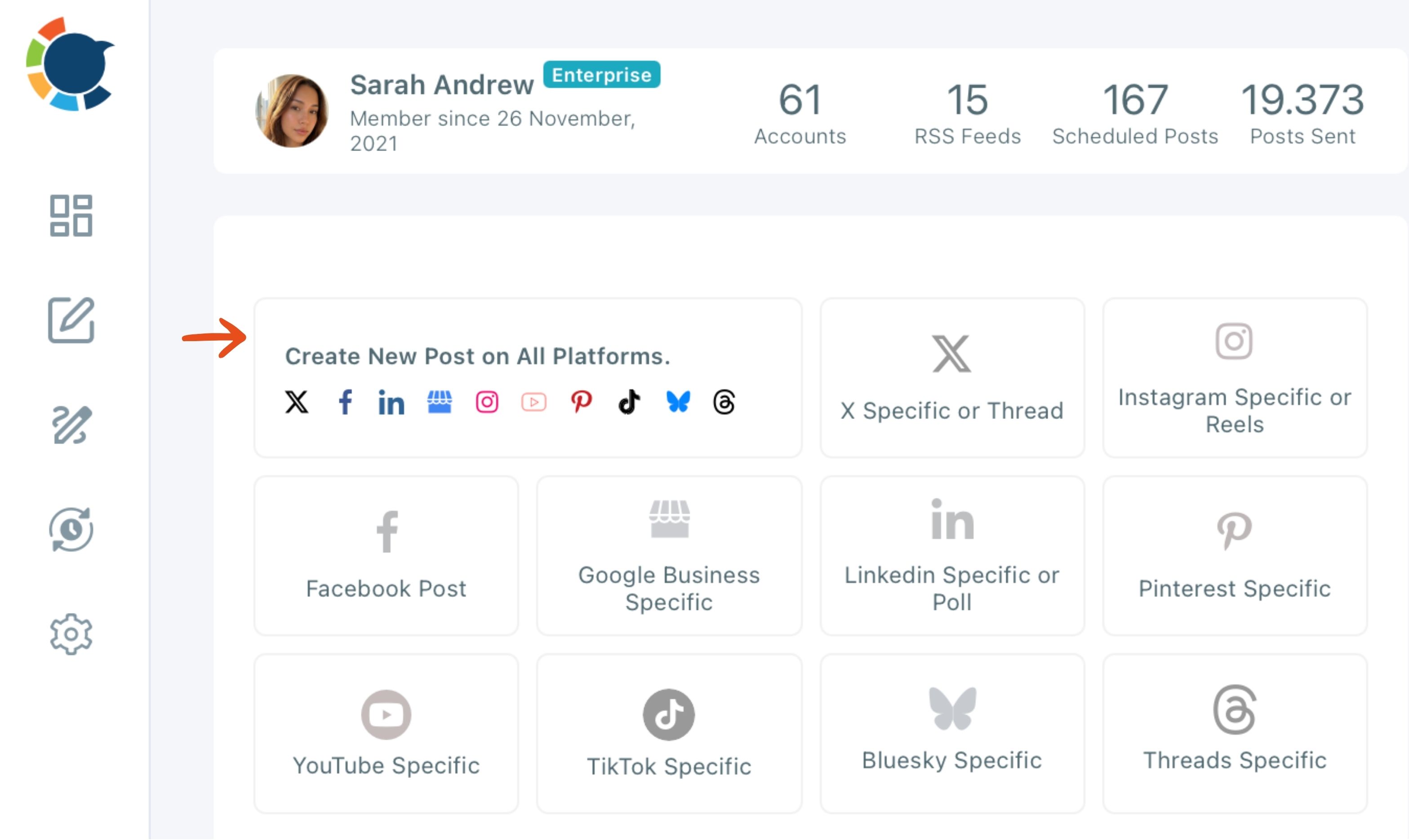
You select the accounts, write the post, check each platform's preview, and send it to all of them at once.
Video works the same way. A single clip can go to Facebook, Instagram, TikTok and YouTube in one action, so you can cross post videos instead of uploading the same file four times.
Timing still matters inside the schedule. Every algorithm rewards posts that earn engagement soon after they go live, which is why a post scheduled while your followers are online starts stronger.
Our guide to the best times to post on social media explains why those windows differ by platform and by audience.
For X specifically, the access question is worth settling before you connect an account. Circleboom is listed on X's Enterprise customer directory, so your posts reach X through approved access, not a password handed to an unofficial tool.
When you are ready to set it up, you can schedule a month of posts that grow your social media presence in one sitting.
A 90-day plan to grow your social media presence from zero
Ninety days is long enough for a posting habit to show its first results, and short enough to stay motivated. The plan below assumes one weekly session of about ninety minutes to two hours, an illustrative budget you can scale up or down.
Days 1 to 30: set up and start the rhythm
- Pick two or three platforms where your audience already is.
- Complete every profile field: name, description, link, category.
- List ten topics your customers search for, and write one post per topic.
- Set queue slots for each account and let the best times fill them.
Days 31 to 60: fill the gaps and add a format
- Keep the weekly session, even when the early numbers look flat.
- Use article curation or reposts for the days with nothing new.
- Add one short video a week and send it to every video platform at once.
Days 61 to 90: read what worked and repeat it
- Look at which topics earned saves, shares and comments.
- Write more posts on those topics, in new angles, and fewer on the rest.
- Rerun the strongest posts for followers who joined later.
Reading the results does not need a dashboard full of charts at this stage. Look for direction, not totals: are more strangers saving, sharing or commenting than a month ago, and which topics brought them?
A topic that pulls in people who never followed you is a topic the platform can match to searches, so it deserves more posts.
The plan stays flexible on purpose. For monthly milestones from a second angle, our guide on how to grow your social media platforms in 3 months covers the same stretch.
What the first year of showing up looks like
Looking back from a year out, the pattern Circleboom's product documentation describes for Facebook Pages is a fair picture of any platform. Around three months in, the first likes, comments and follows start moving. After six months there are more.
After a year, the results are hard to miss.
None of that happens in bursts. It happens because the account kept posting during the weeks you were busy with something else.
The payoff also reaches past the platforms. A steady presence becomes a source of visits to your site, which is the part that pays the bills. Our guide on how to generate website traffic with a 0 marketing budget covers that next step.
Growth from zero is a time trade: one bounded weekly session buys a presence that shows up every day.
If you start this week, the first three months of that curve begin now. You can start growing your social media presence with scheduled posts on the accounts you already have.
Frequently asked growth questions
Can I post the same thing on every platform?
Across different platforms, yes, as long as each version fits that platform's limits. Posting the same text again and again, or the same post to several accounts on one platform, counts as duplicate content. Circleboom's help page on whether you can post duplicate content explains where the line sits.
Why did my reach suddenly drop, and am I shadowbanned?
A sudden, unexplained drop in reach on one platform is the typical sign of a shadowban, where a platform quietly shows an account's posts to fewer people. Check each platform's own guidance first, and keep posting at a steady, queued pace with varied content and genuine engagement, which keeps your activity looking like what it is.
How long until I see my social media presence grow?
Expect months, not days. A consistent account usually sees its first likes, comments and follows start moving around three months in, more after six months, and clear results after a year.