
The audit dashboard showed 14,200 followers and 8,400 following on the operator's account, and the ratio of 1.69-to-1 was the headline number she had been monitoring for the quarterly review. The drill-down was the next click.
Of the 8,400 accounts she was following, 3,180 were not following her back; of those 3,180, roughly 940 had unfollowed her at some point in the prior eighteen months without any notification reaching her. The ratio at the surface looked healthy. The decomposition told a different story.
The corrective move was selective unfollows of accounts that no longer followed her back, scoped to accounts that had been inactive for more than 90 days. The decomposition let her run the cleanup as 600 deliberate unfollows rather than as a wholesale 3,180-account purge, and the resulting ratio (14,200 to 7,800) lifted into the band that signaled a healthy curated audience rather than an indiscriminate follow-everyone approach.
The healthy-ratio workflow opens Not Following Back, which loads the operator's following list through the official X Enterprise APIs and isolates accounts that do not follow back. The dashboard surfaces the imbalance, supports filtering by activity date or topic, and exports the candidate set for review before any unfollow action runs. → Audit your follow ratio with Not Following Back
Why the Surface Ratio Misleads More Often Than It Informs
The follower-to-following ratio at the surface is a single number that conflates four different audience dynamics. Aggressive follow-back behavior produces a high ratio without curation; aggressive following without follow-back produces a low ratio with potentially high engagement; silent unfollows distort either pattern by drifting the ratio in the wrong direction without operator awareness; and inactive accounts in the following list contribute to the count without contributing to the engagement.
The four dynamics each call for different corrective action, and the surface ratio cannot distinguish among them. The decomposition that produces a useful corrective action starts with the question "who am I following that does not follow me back?" and proceeds through the filters that determine which subset of those accounts is worth keeping anyway.
The Circleboom piece on whether unfollowing accounts that don't follow back is a good idea covers the strategy-side framing of the decomposition and is the right starting point for operators who want to understand the trade-offs before running the audit.
What a Healthy Follow Ratio Actually Looks Like
A healthy ratio is not a fixed number; it is a ratio that reflects the operator's intentional curation. For most personal accounts, a 2-to-1 or 3-to-1 follower-to-following ratio signals deliberate audience curation. For brand or commercial accounts, ratios above 5-to-1 are common and signal strong external recognition. For early-stage accounts under 1,000 followers, a 1-to-1 or 1.5-to-1 ratio reflects the audience-building phase.
The ratio's value comes from comparing it to the operator's posture, not to a universal benchmark. An account that aspires to thought-leadership positioning should run a higher ratio than an account that focuses on community engagement; an account in audience-building mode should run a lower ratio than an account in audience-curation mode. The audit identifies the gap between the current ratio and the intended posture.
The Circleboom piece on the best Twitter follow-back checker tools covers the tool-side framing and the operator-led criteria for picking which accounts to unfollow during the corrective pass.
How to Keep Your Twitter Follow Ratio Healthy Step by Step
The workflow runs in two phases: the decomposition audit, then the selective unfollow pass. The audit takes 10 to 20 minutes; the unfollow pass runs in rate-limited batches.
Phase 1: Decompose the Ratio
Log in to Circleboom Twitter
- Log in to Circleboom Twitter with the X account being audited. OAuth keeps credentials with X directly and pulls the following and follower data through the sanctioned API.
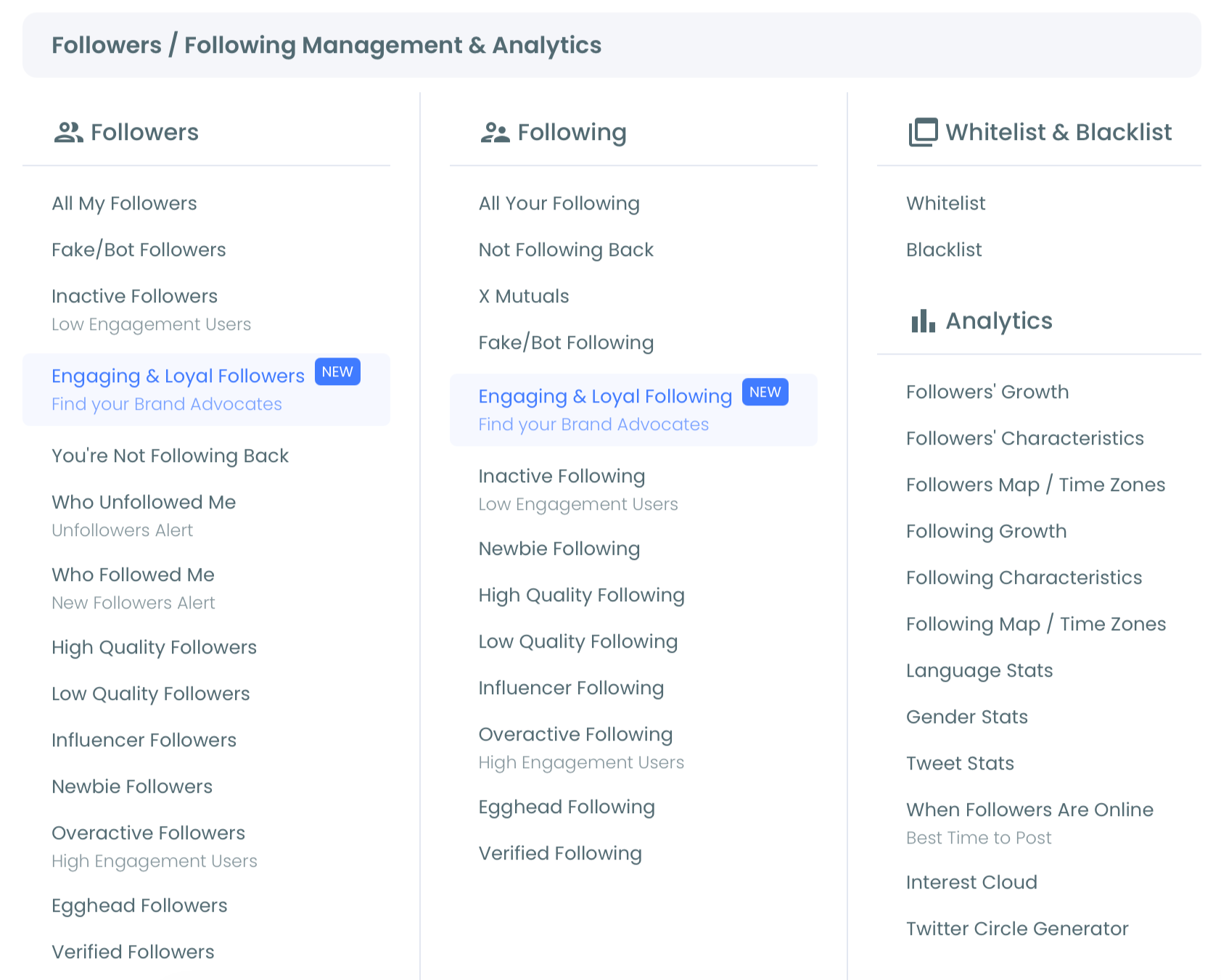
Open Not Following Back under the Follower-Following menu
- Open Not Following Back in the Follower-Following menu under the Audience Insights grouping. The tool isolates accounts the operator follows that do not follow back.
Sort the candidate set by activity date and follow date
- Sort the candidate set by most-recent activity date and original follow date. Inactive accounts cluster at one end of the sort; long-standing follows the operator wants to preserve cluster at the other end.
Phase 2: Run the Selective Unfollow
Apply the activity-date filter to exclude long-dormant accounts
- Apply the activity-date filter to exclude accounts dormant beyond a chosen threshold (commonly 90 days). The filtered set is the operational unfollow target; accounts active recently usually stay in the following list even without follow-back.
Review the filtered set for context-relevant exceptions
- Review the filtered set for accounts the operator wants to keep regardless of follow-back status. Major institutions, thought leaders, and content sources often warrant follow-without-reciprocation; mark them for preservation before the batch runs.
Confirm the selective unfollow batch
- Confirm the selective unfollow and let the batch execute through the sanctioned API. The platform processes batches in rate-limited waves; a 500-account unfollow typically completes within an hour.
The six-step sequence is the full workflow. The decomposition is the strategic input; the unfollow execution is mechanical.
Video walkthrough: how to check and unfollow non-followers on Twitter.
What the Healthy Ratio Produces for the Operator
The output is a follow ratio that reflects deliberate curation rather than the residue of historical follow-back behavior. The operator's following list contains accounts the operator actually wants to follow; the follower count reflects the audience the operator has built; the ratio at the surface matches the intentional posture.
The compounding payoff lands in the recommendation feed. The platform's algorithm reads the operator's following list as a signal of interest; a curated following list produces a more relevant recommendation feed, which produces better discovery and engagement.
The Circleboom piece on who doesn't follow back on Twitter covers the audience-side framing of why the decomposition matters and is the natural pairing for operators who want to understand the second-order effects.
Two adjacent surfaces extend the ratio audit. The Who Unfollowed Me landing covers the inverse view, which accounts that previously followed the operator have since left, and pairs with Not Following Back for the full follow-side audit.
The Twitter Unfollow Tool landing covers the execution-side surface for operators who want a unified unfollow workspace.
Related Circleboom reading on the follow-ratio theme.
- How to auto-unfollow accounts not following back on Twitter on the automation side of the workflow that handles the maintenance audit.
Where the Workflow Goes Next
A first audit usually surfaces 20 to 40% of the operator's following list as legacy follows that no longer fit the current posture. The corrective pass typically removes 10 to 25% of the following list, leaving the curated remainder. The maintenance audit runs quarterly and catches the new drift before it accumulates.
Audit your follow ratio with Not Following Back and the ratio stops being a number the operator hopes is healthy and starts being a deliberate output of a recurring curation routine.
Common Questions About Twitter Follow Ratio
Is there an ideal follow ratio I should target?
No universal target exists. The right ratio reflects the operator's posture: personal accounts often land between 2-to-1 and 5-to-1; brand accounts run higher; community accounts run lower. The audit identifies the gap between the current ratio and the intended posture rather than against a fixed external benchmark, and the corrective action closes the gap incrementally rather than wholesale.
How does the platform's recommendation system use my following list?
The platform reads the following list as a strong interest signal: the accounts the operator follows shape the topics, formats, and creators that the recommendation feed surfaces. A bloated following list with many inactive or off-topic accounts dilutes the signal; a curated list sharpens it. The recommendation feed is the most visible second-order effect of the curation pass.
Should I unfollow everyone who doesn't follow me back?
No. The decomposition exists precisely to avoid the wholesale-purge approach. Major institutions, thought leaders, news sources, and content creators often warrant follow-without-reciprocation because the operator's interest in their content is independent of any reciprocal relationship. The selective unfollow targets the accounts that no longer fit the current interest profile, not every non-reciprocator.
Will mass unfollows affect my account standing on the platform?
The sanctioned API handles unfollows at rate-limited batch sizes that respect platform-level usage norms. Unfollows of a few hundred accounts per session are well within normal user behavior; thousands of unfollows in a single session can attract platform attention, which is why the workflow distributes the unfollows in waves rather than running them as a single blast. The pacing keeps the account standing intact during cleanup.
How often should I run the follow-ratio audit?
A quarterly cadence catches drift before it accumulates and keeps each audit short enough that the cognitive load is manageable. Heavy-follow accounts (operators who follow many new accounts each month) sometimes shift to monthly; archival or maintenance-mode accounts can run twice-yearly without losing accuracy. The cadence is operator-tunable.