
Your reach dropped for one of two reasons: an algorithmic visibility restriction on your account, or a non-restriction cause like content fatigue, audience drift, or a follower base full of inactive accounts. Telling them apart is the whole job, because the fix for each is completely different.
Why did your Twitter reach suddenly drop?
Usually it is a visibility restriction (a shadowban) or a non-ban cause such as weaker content, time-zone drift in your audience, or inactive followers diluting your early engagement. Circleboom's Twitter Shadowban Test checks your X account against five named visibility limits in seconds, safely and within X's rules, so you can see which one you are facing.
→ run a Twitter reach drop diagnosis
Most guides treat this as a yes-or-no shadowban question. That framing is what keeps people stuck. A real diagnosis separates the five distinct restriction types from the far more common causes that have nothing to do with a penalty at all.
What a reach drop actually is
Reach is how many accounts see your posts. When it falls, the impression count in your native analytics drops, but the number alone never tells you why. X can rank a post lower, hide your replies, or stop suggesting your account in search, and none of that shows up as a labeled warning.
That silence is the problem. You see fewer impressions and you guess. Guessing leads people to rewrite hooks and change posting times when the real issue is a search blackout or a reply filter that no amount of better copy will fix.
A drop has a shape. An overnight cliff, where impressions fall 80 percent between one day and the next, points to an account-level restriction. A slow month-long fade points to strategy, audience, or follower quality. Reading that shape first saves you from fixing the wrong thing.
X itself is open that visibility is not guaranteed. Its approach to recommendations explains that freedom of speech is not freedom of reach, and that the platform ranks and filters content. So a reach drop is sometimes the system working as designed, not a glitch.
The five visibility limits worth checking
Circleboom's Shadowban Test does not return a single verdict. It checks your X account against five specific restriction types and gives a pass-or-issue result for each, with an expandable explanation. That structure is what turns a vague worry into a named cause.
The five checks cover different parts of how X distributes you:
- Search Suggestion Shadow hides you from search suggestions and People results for anyone outside your existing circle.
- Total Search Blackout removes your tweets and hashtags from search entirely.
- Reply Lock hides your replies from other users while they still look normal to you.
- Reply Visibility Filter pushes your replies behind a "Show more" barrier in threads.
- Early Engagement Seed weakens distribution when inactive followers fill the small group X shows a new post to first.
Each one needs a different response. A search blackout means new audiences cannot find you no matter what you post. A weak engagement seed means your follower base, not your content, is throttling distribution.
How to run a Twitter reach drop diagnosis
You can check any public account without logging in. The flow is short and gives you a per-restriction breakdown rather than a single label.
The process, in order:
- Open the Twitter Shadowban Test from Circleboom's free toolkit.
- Type the X username into the input field, with the @ prefix already provided.
- Click Search and let Circleboom evaluate the account against all five restriction types.
- Read the summary verdict at the top, then expand each of the five checks to see its status and explanation.
A clean account returns a banner like "Fantastic! The account has no shadow bans in any country." If that is your result, the cause is not a restriction, and your attention should move to content and audience signals instead.
Logged-in Circleboom users reach the same test inside the Essential Toolbox menu, next to the rest of the audience tools.
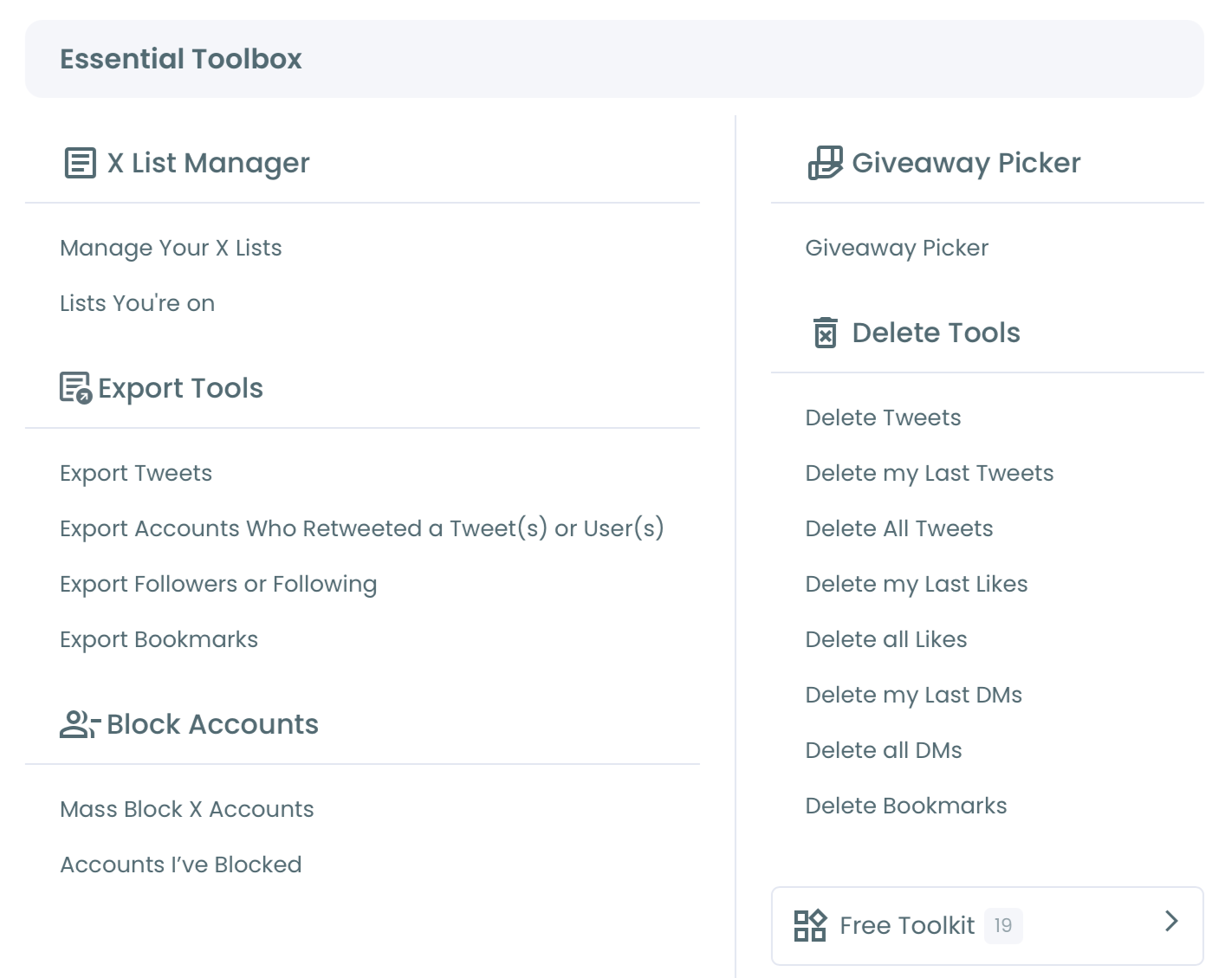
That sequence works because it rules causes out in the right order. The test confirms or clears the account-level restrictions first, the ones you cannot fix by posting differently, so you only move to content and audience theories once a penalty is off the table.
See it live: how a sudden impression drop maps to the specific shadowban check behind it.
When the test comes back clean
A clean test is a result, not a dead end. It tells you the throttle is somewhere in your content or your audience, and both are diagnosable with data instead of guesswork.
Start with the slope. Pull your Twitter post analytics and look at whether impressions fell off a cliff or faded slowly. A fade usually means your recent posts earned less early engagement, which tells X to distribute them less.
Then look at who follows you. If a large share of your followers are inactive or fake, your Early Engagement Seed is structurally weak, because those accounts occupy the first distribution group and never interact. A Twitter account analytics review shows the composition behind that number. This is also why a reach problem and a follower-quality problem so often turn out to be the same problem.
Circleboom is an official X Enterprise Developer company. Every check and every analytics pull runs on sanctioned data access rather than scraping, which keeps your account safe while you investigate.
Why diagnosis beats reaction
The instinct after a reach drop is to act fast: post more, post less, delete tweets, change your bio. Acting before diagnosing usually makes the picture muddier, because you change several variables at once and can no longer tell which one mattered.
A named cause gives you a single lever. If the issue is a Reply Lock, you ease off automated-looking activity and wait it out. If it is a weak engagement seed, you clean inactive followers. If the test is clean and the slope is a slow fade, you fix the content. One diagnosis, one move.
There is also a baseline benefit. Running the test periodically, not just in a panic, gives you a reference point. The next time impressions wobble, you already know what "normal" looks like for the account, and you can tell a real restriction from ordinary daily variance.
Common Questions About Diagnosing a Reach Drop
How do I know if my reach drop is a shadowban or just low engagement?
Run the Shadowban Test first. If all five checks pass, it is not a restriction, and the cause is content or audience related. A clean test plus a slow impression fade almost always points to engagement, not a penalty.
Can inactive or bot followers really lower my reach?
Yes. X shows each new post to a small seed group of your followers first, and if inactive accounts fill that group, they never engage, so the post never earns wider distribution. Cleaning that base often restores reach without changing anything about your content.
How long does a Twitter visibility restriction last?
It depends on the type. Temporary measures like a Reply Lock often clear within days once the triggering behavior stops, while restrictions tied to account health can persist until the underlying issue is resolved. Here is more on how long a Twitter shadowban lasts.
What should I do once I know the cause?
Match the action to the result. For a confirmed restriction, see how to get unshadowbanned on Twitter. For a clean test, move to content and follower-quality fixes instead of waiting out a ban that does not exist.
The Bottom Line
A reach drop is not a single problem, so it does not have a single fix. The accounts that recover fast are the ones that diagnose before they react: confirm whether a visibility restriction is active, read the impression slope, and check follower quality, in that order. Skip the diagnosis and you spend weeks tuning content that was never the cause.
If you have noticed why your Twitter impressions suddenly dropped and want to know whether it is a penalty or something fixable, start with the named checks. Understanding what a shadowban means on each of those checks is the difference between a real fix and a guess.