
Social strategy has always run on measurement plus a fair amount of guesswork. The guesswork works until the platform rewrites its rules and an account watches its reach fall off.
That's why X, formerly Twitter, releasing part of its recommendation code is worth paying attention to. For the first time, there was something concrete to read instead of a hunch.
The released code is no cheat sheet. What it does give is a far clearer picture of how posts get picked up and pushed out.
Turning that picture into something a team runs every week is the harder part, and it's where a tool built around X does the work. Circleboom is an Official X Enterprise Developer, so the AI Writer, the scheduling tools and the analytics in the Circleboom Twitter tool all run on official X APIs.
Six signals in the code are solid enough to plan against. What follows walks through each one, with the move inside Circleboom that acts on it.
What X actually published
X still carries weight for brand visibility around news moments, live events, industry conversation, and customer support. Real-time distribution and public replies keep it one of the few places a small account can catch a wave and reach far past its size.
The repository is public on GitHub, showing how candidate tweets get gathered and scored, and how safety and quality filters run before anything lands in a For You feed.
Two companions fill in the detail: X Engineering's own explainer (Twitter Recommendation Algorithm) and a plain-language overview from The Verge.
The value comes down to two things. Transparency makes the rules legible and rebuilds some trust in a shifting environment, and the EU's Digital Services Act pushes large platforms in the same direction.
It also hands brands a real starting point, so decisions about topics, formats, and cadence can follow how the system weighs content instead of tracking a guess.
The six ranking signals
The six that follow are the ones concrete enough to act on. Three carry most of the weight: engagement, relevance, and personalization are where the system makes its sharpest calls, and the other three set the conditions that let those land.
Each is paired with the part of Circleboom that turns it from a principle into something on the schedule.
Engagement
The recommendation system tries to predict what a person will do with a post. Will they reply, like, repost, or click?
It ranks based on those predictions. Engagement here works as a proxy for usefulness: the platform's best guess at whether a post earns someone's time.
The weightings differ.
A reply that kicks off an actual back-and-forth counts for more than a like tapped on the way past. Reposts and profile clicks read as wider interest. Pulling the other way, and harder, are the negative signals: a mute, a block, a spam report, each drags a post's distribution down.
Threads are what earn replies with any consistency. A sharp opening tweet, then two or three follow-ups that carry the context and the chart and the link. Each tweet in that thread becomes another surface the algorithm can recommend.
Building those by hand is where momentum dies, and it's the first place the X Post Planner in the Circleboom Twitter tool earns its place.
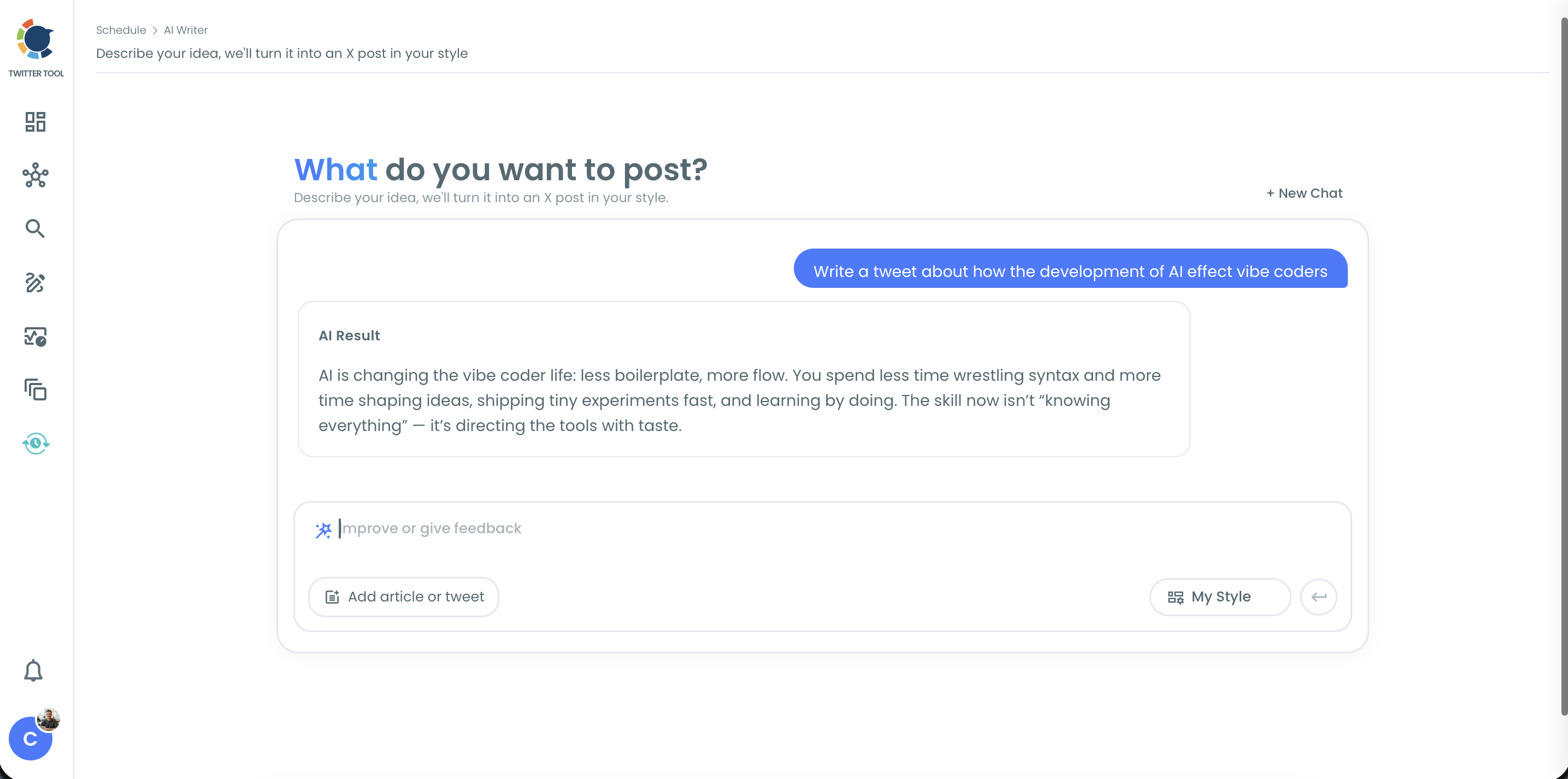
The AI Writer feature lays out the sequence in a single view and drafts an opening built to pull replies from nothing more than a prompt. The same step turns an article URL, an existing post, or a block of text into a full thread with the Twitter thread maker, so one strong idea can be worked into several angles without facing a blank box.
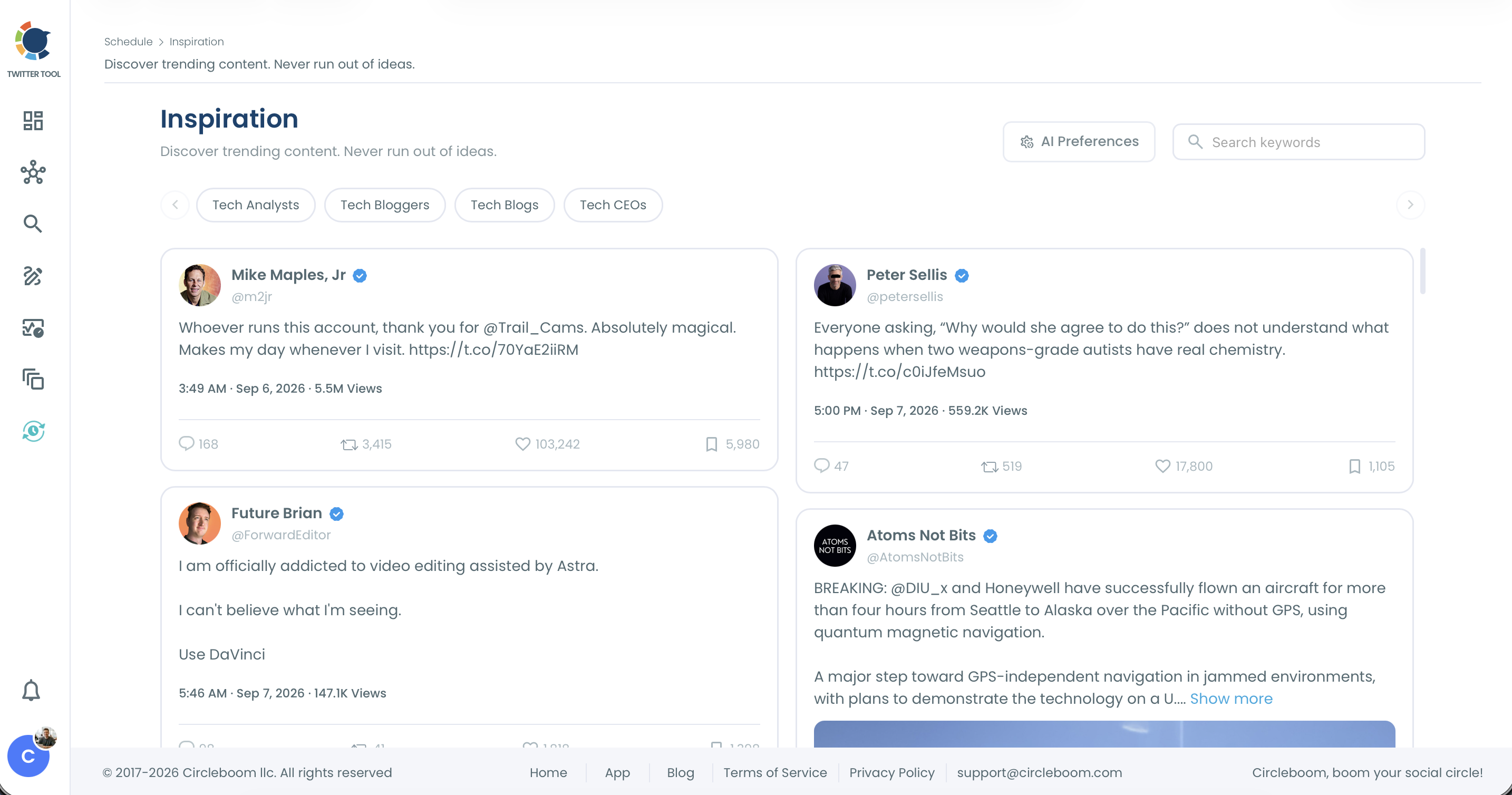
The harder question is what the thread should be about, and that's where the Inspiration feature comes in. It surfaces trending posts and content ideas by topic and keyword, so a thread can start from something already moving in the niche instead of a guess. Each trending post also comes with an AI rewrite, reply or quote.
Search a topic, see what's landing, and the hook writes itself off real signal rather than instinct.
Once the thread exists, the goal is to seed that early cluster of activity fast, because that first wave of replies is what tells the system a post is moving.
Content relevance
Predicting actions only gets a post so far. It still has to match the person seeing it. X works out relevance from the account's network, the communities it sits in, and how similar the content is to things a user already engages with.
Fitting the moment comes down to word choice. The audience uses certain phrasing in its own posts, and matching that beats reaching for the catch-all terms everyone defaults to.
Circleboom offers two ways in.
The AI Writer can generate a post from a URL or an existing tweet, and its My Style option keeps the draft in your own voice, which pulls the framing toward how a specific audience actually talks rather than a generic draft.
The Circleboom Twitter tool's hashtag and account search pulls up the exact phrasing and the questions that keep coming up inside a niche, so themes get tied to real community interest before a single word is drafted.
Jason Ledbetter, operator of a B2B marketing practice, spends his days matching a client's message to the people most likely to act on it.
He says, "The biggest waste in marketing is a strong message pointed at the wrong room. I spend more time figuring out who I am talking to than what I am saying, because the same post lands or dies depending on whether it reached people who already care about the topic. Relevance is not a nicety here, it is the whole job."
Load the hook into the first 100 to 120 characters, and the relevance signal has already done its work by the time a reader decides whether to stay.
User behavior
History drives what comes next. Someone who replies often sees more; an account that gets muted or has its replies hidden watches its reach erode.
Steering that means knowing who actually engages, and this is the Circleboom Twitter tool's home ground. Its follower and unfollower analysis shows who is leaning in and who has drifted, and the Fake/Bot Followers feature clears out the accounts that dilute the real signal.
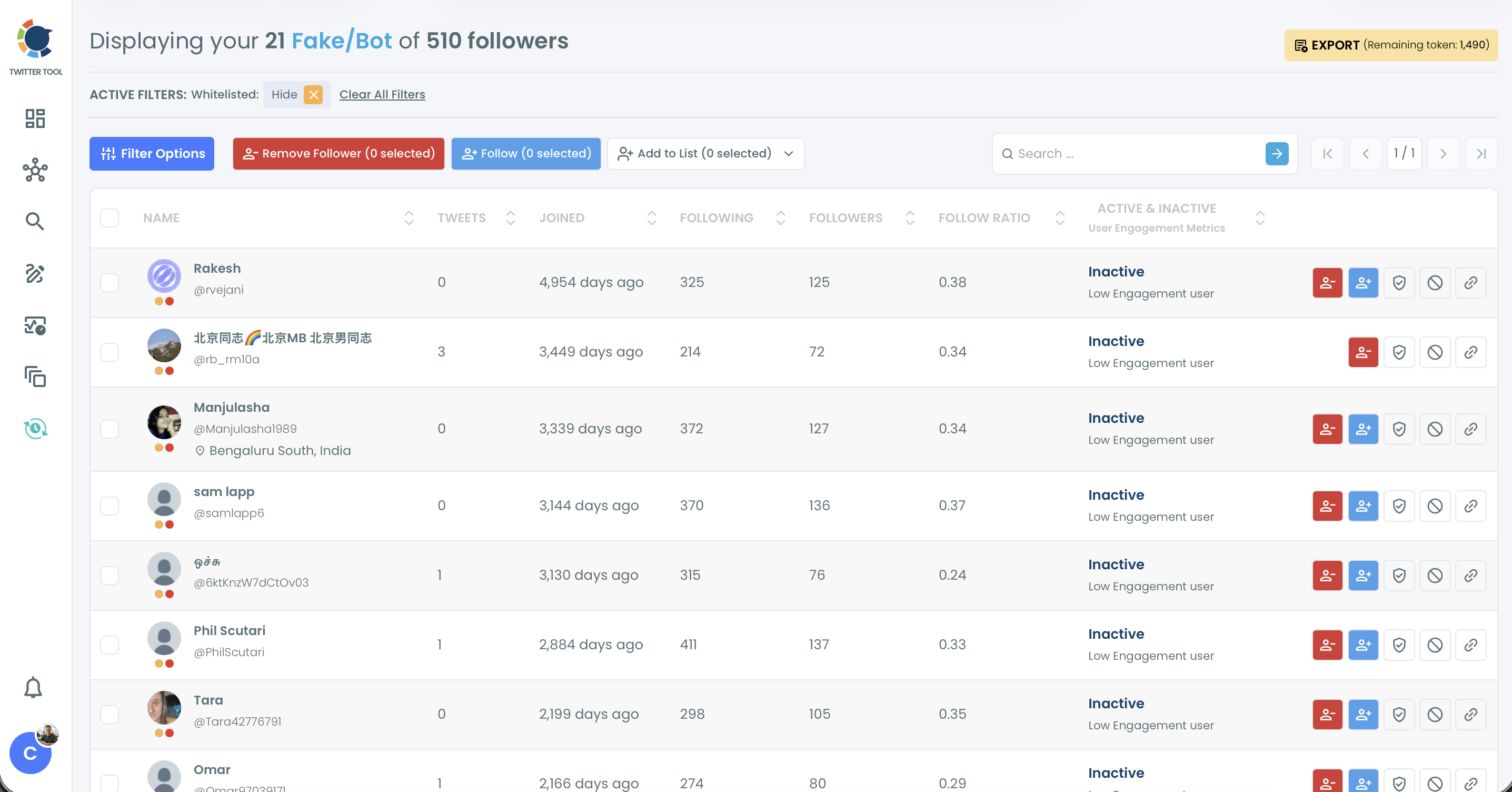
Cleanup is the other half. Bulk tweet deletion retires old low-value posts that drag an account's profile down, so the history the algorithm reads reflects what the account is now rather than what it was three years ago. The low-engagement tweet cleanup page shows how to find them by likes, retweets and impressions.
The behaviors that cost reach are the predictable ones:
Clickbait that overpromises and underdeliversLink dumps posted with no context around themForcing the account into trends that have nothing to do with it
A weekly read of the Post Analytics is what catches a format starting to earn hides before it does lasting damage.
Conrad Wang, Managing Director of EnableU, runs a health and wellness company that depends on reaching the right audience rather than the widest one.
He says, "Reach for its own sake is a vanity number. We learned to read the quieter signals first, who keeps coming back, who drops off, who was never a real follower to begin with, because a smaller audience that actually engages moves the business and a big dead one does not. Cleaning out the accounts that were never going to convert did more for us than any growth push."
Recency and frequency
Fresh posts surface more easily, because the engine weighs timeliness next to predicted engagement. Regular presence counts, and so does catching the windows when an audience is online.
Knowing those windows is the first half. Circleboom's analytics read when an account's own followers are actually active, and the When Followers Are Online feature marks the best times to post, so the cadence lands when people are there to see it rather than going out into dead air.
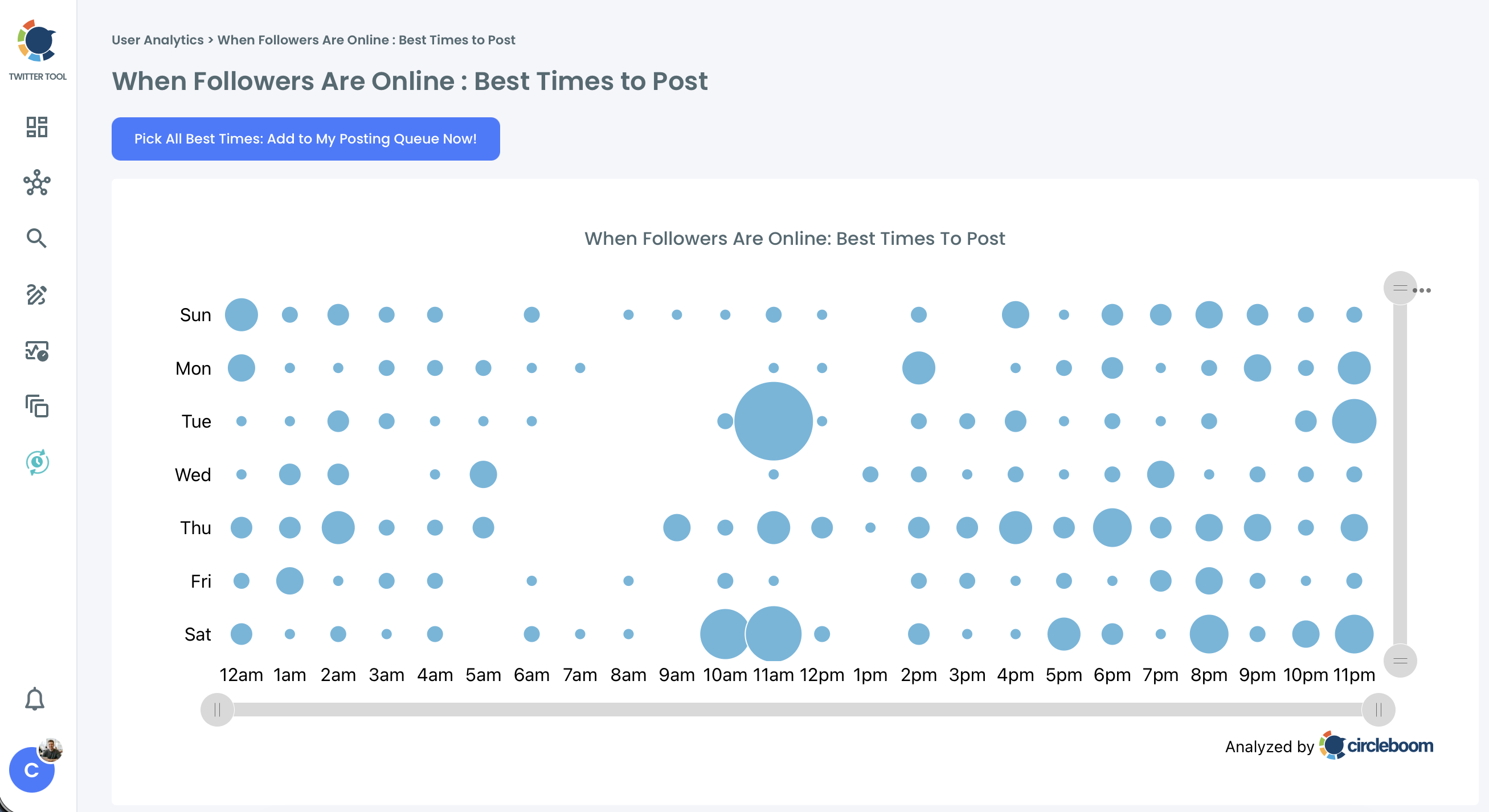
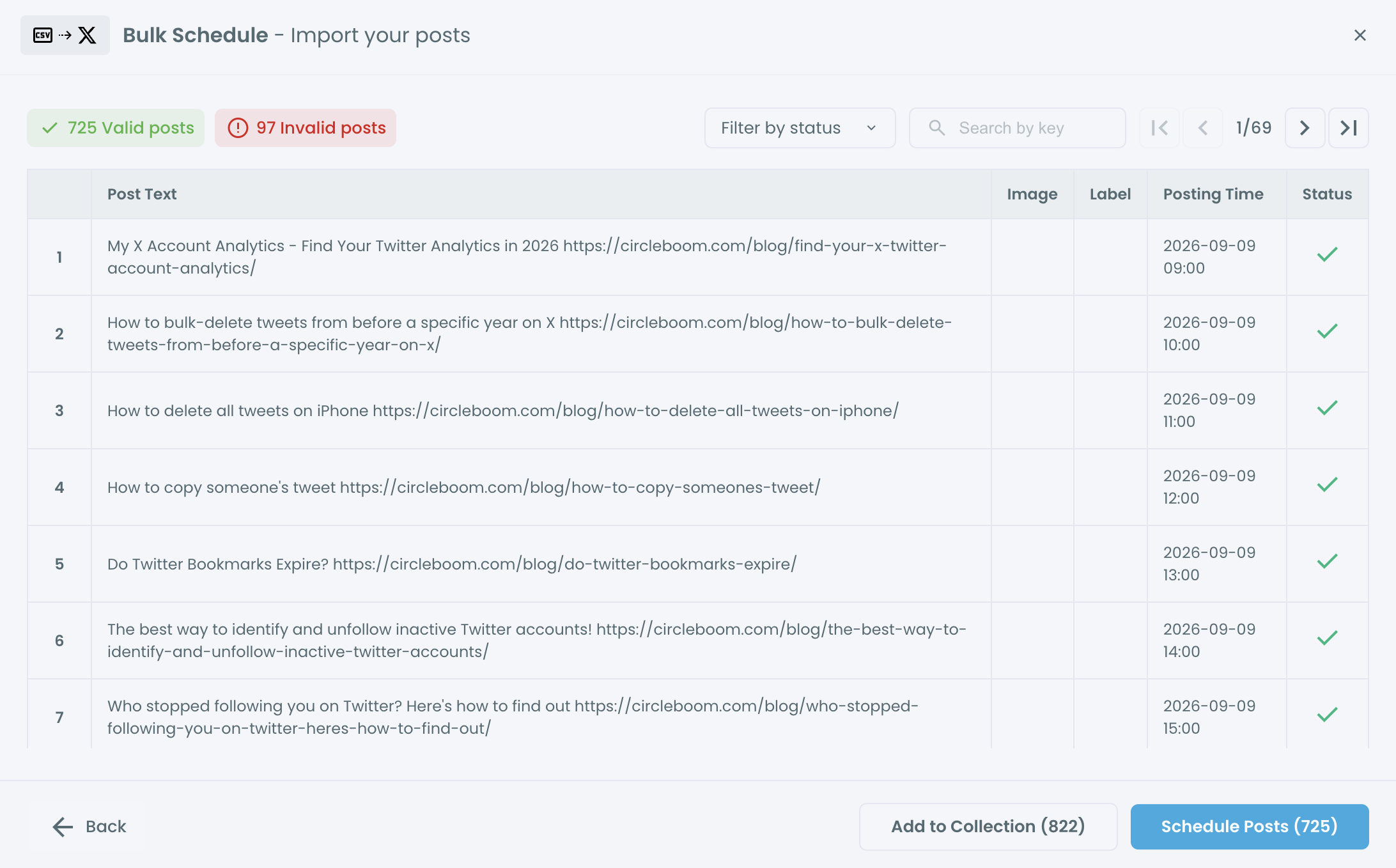
Hitting those windows consistently is the second half, and that's a scheduling job. Bulk Schedule loads a large run of posts from a CSV in one sitting, Queue Up Next spaces them out so the account never reads as spammy, and the whole cadence holds for months without manual posting. Anything can still be shifted live when a post starts to climb.
Hootsuite's guide to best times to post on X (current guide) is a fair place to start testing, though an account's own data settles it over time.
Content quality
Quality here means two separate things: substance and safety. Between the code and the explainer, there are several quality gates described, along with demotions that hit spammy behaviour, repetitive low-value posting, and sensitive categories. Anything that pulls reports, hides, or safety flags gets less distribution.
Keeping the bar high is unglamorous. Write clearly and specifically. Put an original visual on it rather than a bare link.
The Circleboom composer handles the image step in the same window where the post gets scheduled: upload a chart, pull stock from Unsplash, or drop in a GIF, so there's no bouncing out to a second tool mid-draft.
Cite the source whenever a stat or chart goes in. The AI Writer handles the first draft, but a person still checks it before it ships, and that check is what stops the output drifting into auto-generated filler.
The traps are just as consistent:
A thread with no throughline, where the first tweet can't stand on its own, loses people immediatelyTag-stuffing and off-topic hashtags read as noiseLow-effort bait like "reply yes if you agree" produces nothing the system counts as real conversation
Personalization
Personalization runs hard on X. The system weighs the account relationship, shared communities, and how similar content performed with comparable users. That rewards tailoring output to specific slices of an audience.
Inside the X Post Planner, content gets labeled by theme and audience and runs as recurring series through the queue, so each segment gets a consistent stream it recognizes.
One idea can be cut several ways for different slices of an audience, the same way a brand might run custom sweatshirts for one segment and custom jackets for another, each framed for who's buying.
Circleboom's analytics then show how each post type and topic performed, which is what tells the next round of variants where to go.
Building a plan around the signals in Circleboom
All of it fits on a single page, and that page lines up with one Circleboom dashboard:
Choose three content themes tied to actual community interests, and give each a weekly slot in the schedulerFor every planned post, write the conversation starter first, then let the AI Writer draft from itLock two publishing windows from Circleboom's timing data and hold them until the numbers say otherwiseRun one recurring series per audience segment through the queue, framed the same way each time so people recognize itBefore anything publishes, a sixty-second preflight: source link, visual clarity, caption readability, toneOnce a week, review the best and worst performers in the analytics. Keep what works, repair what's close, drop what drags
Keeping the whole process documented is what makes it repeatable, the same reason legal teams run contract lifecycle management software instead of tracking agreements by memory. Treat a platform change as a product update. After a major announcement, a calm skim of the repo or a trustworthy summary flags what touches the themes in rotation, and from there it is one variable tested at a time.
Monthly is the right rhythm for the deeper look. Pull post-level engagement, negative-feedback rates, and follower growth from Circleboom's X analytics, then group by theme and format so the comparison is like for like. Name two experiments for the next month, such as a new hook style, a different visual format or a new posting window, and record both the decision and the result.
Where to start
The published code mostly confirms what steady operators already suspected, but it swaps instinct for something closer to rails. The accounts that gain from it skip the hacks: they sharpen their topics, build posts that invite a reply, and hold a cadence long enough to learn from it.
Circleboom is what makes that repeatable: the X Post Planner and AI Writer for drafting, designing, and scheduling, and the Circleboom Twitter tool's analytics and cleanup underneath.
The code is open, and the moves that act on it live in one place. Take a look at Circleboom, connect an X account, and let the first cycle of data come back.